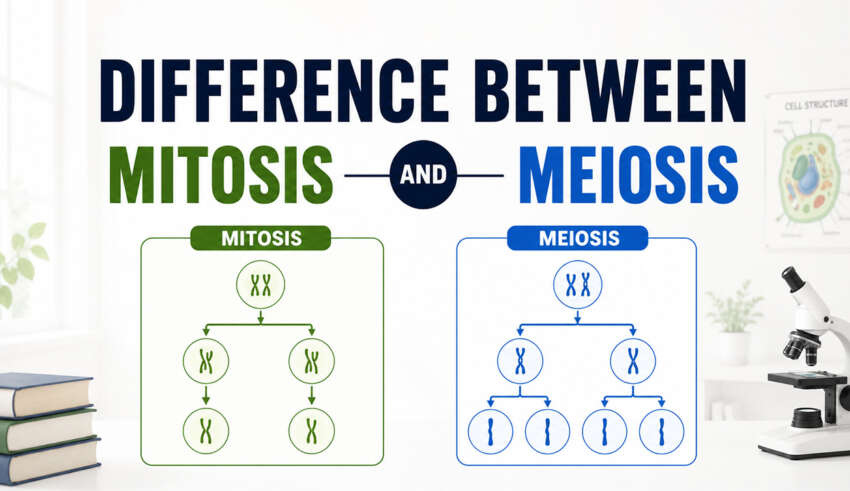
Every second, thousands of cells in your body are dividing. There are some of them that are replacing the old skin cells. Others are stitching up a little cut on the finger. And at other moments in life, some are producing the sperm or egg cells that enable reproduction. This is all done by cell division; however, not of the same type. The difference between mitosis and meiosis is what separates everyday cell repair from the creation of new life altogether.
Students often treat these two as interchangeable, which leads to a lot of confusion in exams. They are not the same. They have different purposes, different outcomes, and different numbers of steps. This guide will walk you through both what they are, the phases of mitosis and the stages of meiosis, what makes them similar, and a detailed mitosis vs meiosis comparison so that by the end, the difference is crystal clear.
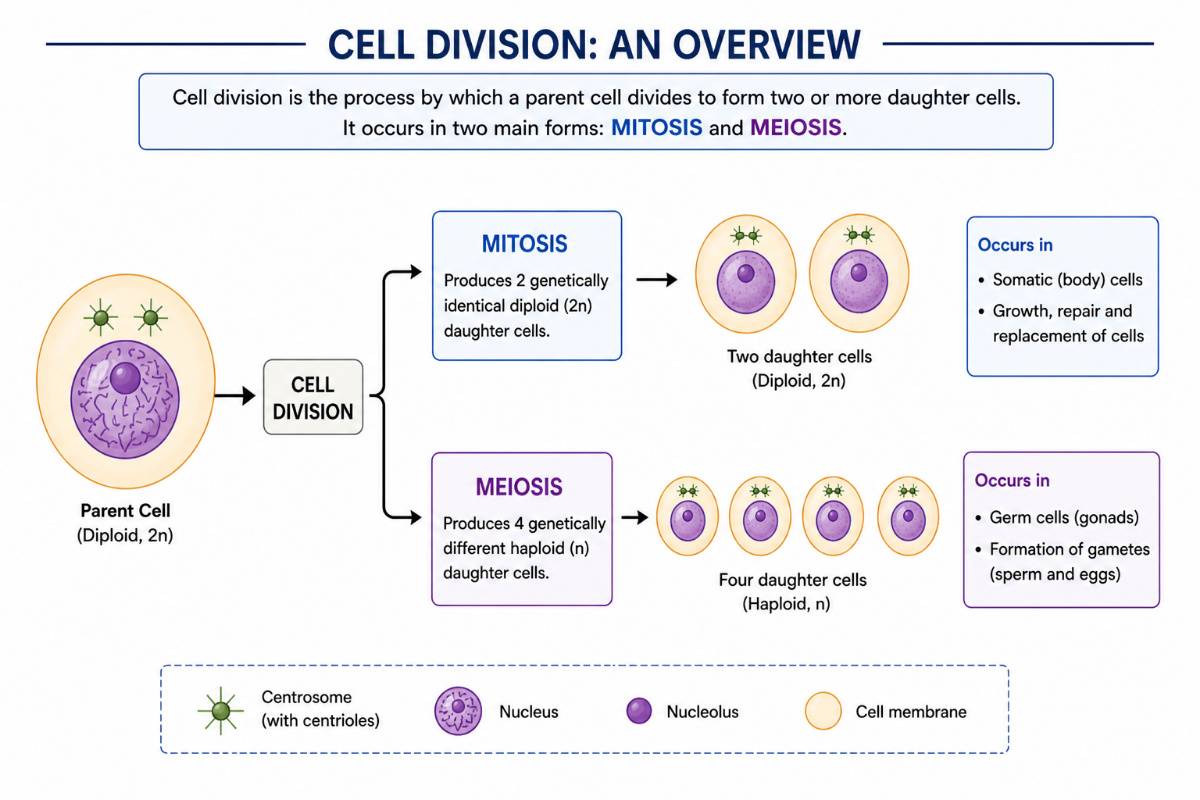
Quick Review of Mitosis vs Meiosis: In the process of mitosis, 2 identical diploid daughter cells are formed, which further helps in the growth and repair of the body. Meiosis is a process that helps in sexual reproduction in humans, and in this process 4 genetically different haploid cells are formed. The primary difference in mitosis and meiosis is that mitosis maintains the number of chromosomes the same (2n n 2n), whereas, on the other hand, the number of chromosomes in meiosis is half (2n n).
Check Out: NEET 2026 Syllabus PDF Released by NTA: Download For Physics, Chemistry, Biology
What is Cell Division?
To dive into the comparison, it would be useful to comprehend that cell division is merely the procedure through which one parent cell divides into new daughter cells. In eukaryotic organisms, like animals, plants and fungi, cell division occurs in two primary mechanisms: mitosis and meiosis. In Prokaryotes, such as bacteria, a different process that is called binary fission.
Cell division can be seen as a kind of photocopier: there are occasions when you would like to have an exact copy (mitosis), and there are occasions when you would like to mix things before printing (meiosis).
What is Mitosis?
Mitosis is a type of cell division in which a parent cell divides itself into two identical daughter cells. The human cell initially has 46 chromosomes and both the daughter cells possess the same amount. Mitosis is an equational division, i.e. the number of chromosomes remains unchanged.
Mitosis happens in somatic cells, all the non-reproductive cells in your body. It is in charge of:
- Expansion of the body out of a single fertilised egg up to trillions of cells.
- When you get an injury and repair the damaged tissue, mitosis is the one that is doing the job.
- It is a continuous process of renewing red blood cells, skin cells, and gut lining because old or worn-out ones are replaced.
Valuable Insight: Walther Flemming was the first to describe the process of mitosis in 1882. When the cell division fails during mitosis, there is uncontrolled growth, and this is what we call cancer. That is why it is of medical importance to learn about mitosis.
Check Out: Most Repeated Questions in NEET Exam for 2026: Check Key Topics to Score High
Phases of Mitosis (Step by Step)
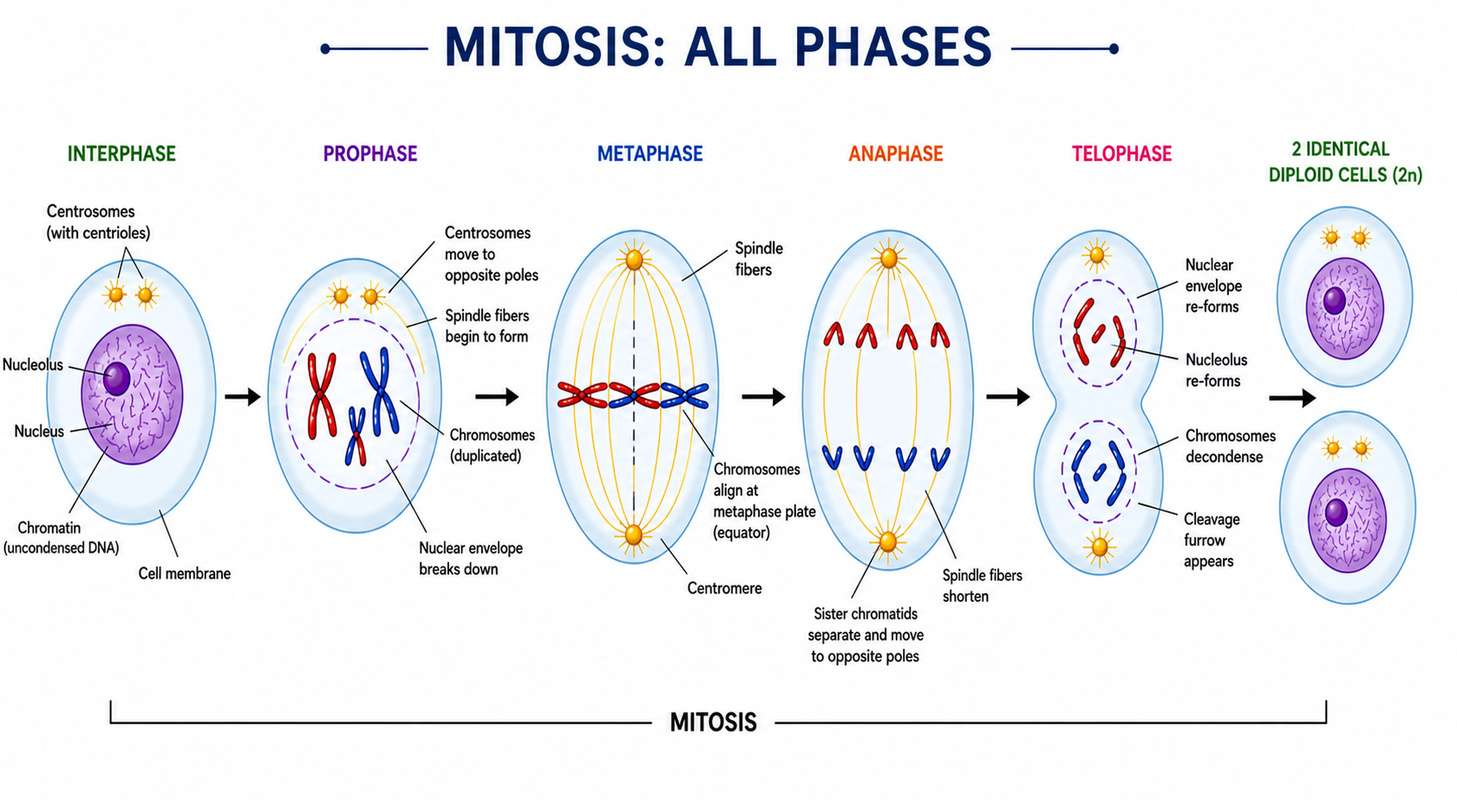
The cell passes through interphase before the process of mitosis begins, and it is a preparation phase during which the cell develops, replicates its DNA and prepares to meet the challenge of dividing. The copies are made of each chromosome, and therefore, the cell now contains two identical copies of the same chromosome, referred to as sister chromatids, joined together at a point known as the centromere. After this is carried out, mitosis will occur in four stages.
1. Prophase
Chromosomes appear and condense. The nuclear envelope is torn out. The spindle fibres start forming with structures that are known as centrioles. These centrioles later divide the chromosomes. This is the first indication that denotes that separation is going to be done.
2. Metaphase
Metaphase is known as the most organised stage in mitosis. All the chromosomes are centrally aligned in the middle of the cell at a point known as the metaphase plate. Each centromere is attached by spindle fibres at one end. Such a nice setup means that each daughter cell receives an equal portion when the chromosomes are pulled apart.
3. Anaphase
The sister chromatids are drawn apart. The spindle fibres become short and drag a copy of each chromosome to each end of the cell. Now, when you put it under the microscope, you would find that there are two sets of identical chromosomes that are moving in opposite directions.
4. Telophase
Nuclear envelope reforms around each group of chromosomes at the two poles. The chromosomes loosen and once more become less visible. The cell then proceeds to cytokinesis, the actual division of the cell into two, resulting in the formation of two genetically identical daughter cells, each having 46 chromosomes (2n).
What is Meiosis?
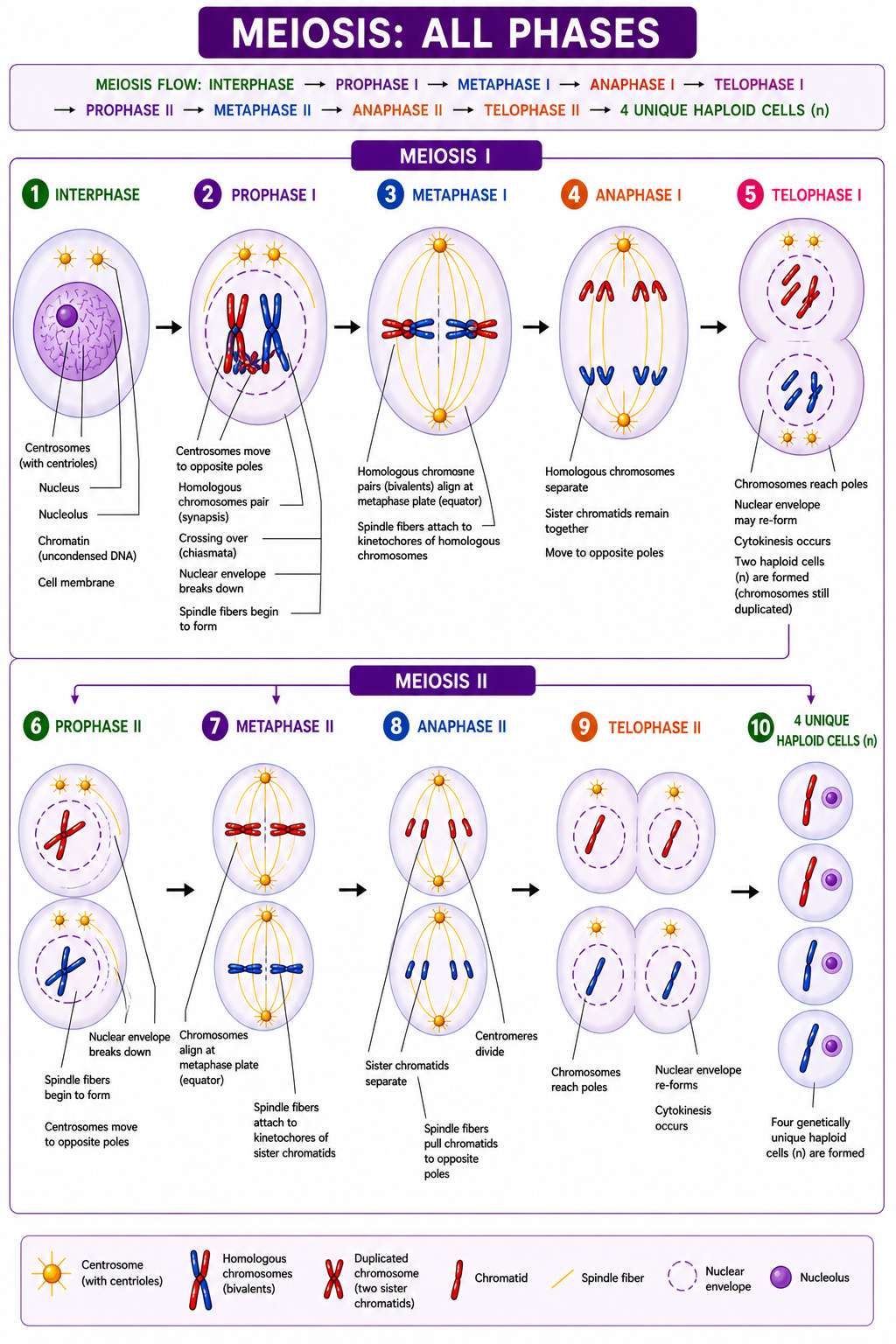
Meiosis is a specialised cell division that occurs only in reproductive cells, cells that produce sperm and eggs (gametes). In contrast to mitosis, meiosis is a two-round division that is referred to as Meiosis I and Meiosis II. The outcome is four genetically distinct haploid cells, each having half the number of chromosomes of the parent cell (in humans, 23 rather than 46).
The process of meiosis is a reductional division as it leads to a decrease in the number of chromosomes by half. This is an essential cut. During fertilisation, a sperm and an egg cell merge, bringing with them 23 chromosomes, which is the complete set of 46 chromosomes in the new living being.
Valuable Insight: It is due to meiosis that no two people are genetically identical, with the exception of identical twins. Whenever meiosis takes place, genetic material is reshuffled in a manner that has never and will never happen again in a very similar manner. It is one of the most outstanding processes in the whole of biology.
Check Out: Most Easy and Scoring Chapters for NEET 2026 Exam in Physics, Chemistry & Biology
Stages of Meiosis I – The Reductional Division
The first and more complicated of the two rounds is meiosis I. It is here that the chromosomes are actually divided in half, and here is where genetic variation is mainly formed. Similar to mitosis, it is preceded by an Interphase where the replication of DNA occurs.
1. Prophase I
This is the longest and most important stage of the entire process of meiosis. The similar chromosomes (homologous chromosomes), one belonging to your mother, and the other to your father, are drawn together and joined closely, a process known as synapsis. During meiosis, non-sister chromatids (paired) swap genetic material at locations known as chiasmata. This is known as crossing over during meiosis, and it is the largest contributor of genetic variation in sexually reproducing organisms. New combinations of genes are formed that never existed in either parent.
2. Metaphase I
The bivalents or tetrads of homologous chromosomes now align at the metaphase plate. Notably, the direction of each couple is at random. One pair could be with the maternal chromosome on the left and the paternal chromosome on the right, and the other could be the reverse. This haphazard distribution is termed independent assortment, and this further incorporates another layer of genetic variation to the existing crossing over.
3. Anaphase I
Homologous chromosomes are drawn towards opposite poles of the cell. Remember that we are separating here entire chromosomes, not sister chromatids (which occurs during Meiosis II). It is at this point that the number of chromosomes is literally reduced by half: the poles now contain 23 chromosomes each, rather than 46, as they did before.
4. Telophase I
Two new cells are created, and both of them are haploid (n), with 23 chromosomes. There may be a short period of rest known as interkinesis, during which Meiosis II can commence, but during the gap, no new DNA replication occurs.
Stages of Meiosis II – The Equational Division
Meiosis II is highly similar to mitosis except that it begins with the haploid cells and not with diploid cells. It does not decrease the number of chromosomes further, but rather, it is the separation of the sister chromatids that had been replicated during the initial interphase.
1. Prophase II
Cells condense their chromosomes once again. There is no crossover at this point. Spindle fibres start to re-form.
2. Metaphase II
Chromosomes, each of which still consists of two sister chromatids, line up at the metaphase plate in each of the two haploid cells.
3. Anaphase II
The centromeres separate, and sister chromatids are dragged towards opposite poles, as in the case of mitotic anaphase. Single-stranded chromosomes are present in each pole.
4. Telophase II + Cytokinesis
Nuclear envelopes reform. The two cells divide to produce a total of four haploid daughter cells. All these are genetically distinct, not the same as the parent cell, nor as each other, due to crossing over and independent assortment in Meiosis I.
Key Differences Between Mitosis and Meiosis – Comparison Table
The following is a table on a detailed mitosis vs meiosis comparison of all the points that are most frequently examined in Class 11 Biology, NEET exam and board exams.
| Basis | Mitosis | Meiosis |
| Type of division | Equational division | Reductional division |
| Number of divisions | One | Two (Meiosis I & II) |
| Daughter cells | 2 identical diploid cells | 4 genetically unique haploid cells |
| Chromosome number | Unchanged (2n → 2n) | Halved (2n → n) |
| Occurs in | Somatic (body) cells | Reproductive (germline) cells |
| Purpose | Growth, repair, cell replacement | Sexual reproduction |
| Genetic variation | None daughter cells are identical | Yes — via crossing over & independent assortment |
| Crossing over | Does not occur | Occurs in Prophase I |
| Cytokinesis | Occurs once (after Telophase) | Occurs twice (after Telophase I & II) |
| Discovered by | Walther Flemming (1882) | Oscar Hertwig (1876) |
Quick Difference Between Mitosis and Meiosis
- Mitosis: 1 division occurs, → results into two identical diploid cells, → leads to growth and repair.
- Meiosis: 2 divisions occur, → results in the formation of four unique haploid cells → helps in sexual reproduction in humans.
- Chromosome count: In mitosis, the count of chromosomes remains the same (2n → 2n), and in meiosis it becomes half (2n → n).
Similarities Between Mitosis and Meiosis
Even though mitosis and meiosis have different outcomes, they share several important features. This is a commonly asked topic in exams, and students often miss this section.
| Mitosis | Meiosis |
| Both start with a single parent cell | DNA replication precedes both processes |
| Both occur in eukaryotic cells. | Both use spindle fibres to move chromosomes. |
| Both go through prophase, metaphase, anaphase, and telophase stages | Both are preceded by interphase |
| Both involve cytokinesis at the end. | Both occur in the nucleus of a cell. |
How Meiosis Creates Genetic Variation (And Why Mitosis Does Not)
The most apparent differences between mitosis and meiosis is what occurs to genetic material. In mitosis, the daughter cells are clones, no reshuffling, no new combinations of genes. Meiosis operates differently, creating variation in two ways:
- Crossing over during meiosis (Prophase I): Homologous chromosomes join and swap DNA strands at an area known as chiasmata. The outcome is that we end up with a chromosome with the genes of both parents and a mixture that has never occurred. This makes each gamete unique genetically.
- Independent assortment (Metaphase I): The orientation of both homologous pairs of chromosomes at the metaphase plate is random. With 23 pairs in humans, this alone creates 2²³ over 8 million possible chromosome combinations per gamete.
Together, these two mechanisms explain why genetic variation in meiosis is so significant; every child born through sexual reproduction is genetically unique. Mitosis produces none of this variation. Its purpose is consistency; meiosis’s purpose is diversity.
Why Both Mitosis and Meiosis Matter in Life?
The knowledge of the biological significance of each process helps students realize that the difference is not important merely to pass exams.
- Growth and repair by mitosis: It is the process of mitosis that replenishes the human body with about 3.8 million cells in each second. And that is mitosis at work every time (race against time phrase meaning) a wound is healed, every time your gut lining starts over, every time new blood cells begin to grow.
- Reproduction by meiosis: Each human being living today is the result of meiosis, which made the sperm and the egg which fused to make them. Sexual reproduction and genetic diversity would not exist without meiosis.
- Medical significance: Mitosis errors may result in uncontrolled cell division, resulting in cancer. Mistakes during meiosis may lead to chromosomal disorders. In the case of Down Syndrome (Trisomy 21), chromosome 21 did not divide during meiosis as it was meant to (nondisjunction) and the child would now have three copies of chromosome 21 in their cells.
Easy Memory Trick to Remember the Difference Between Mitosis and Meiosis
Students often get confused between Mitosis and Meiosis in the exam. So here we have given a trick that can help students remember the difference:
- Mitosis = It performs functions related to body maintenance (It forms 2 identical cells, and helps in keeping the body running)
- Meiosis = It helps in gamete formation (In this process, 4 different cells are formed, and this helps in making reproduction process possible in humans)
Another angle
Both words start with “M”, so focus on the endings. miTOSis = Two cells. meiOSIS = four cells (the extra letters hint at more complexity and more output).
Conclusion
The difference between mitosis and meiosis is really a difference in purpose. Mitosis keeps your body running. It produces the same cells to grow, repair and replace. Reproduction is possible only through meiosis. It produces genetically distinctive gametes, which in turn fuse with those of another individual to produce a completely different individual. They are both cell divisions; they both have a step-by-step order and they are both necessary to life.
| Explore NEET Biology Differences: Important Links | |
| Difference Between Prokaryotic and Eukaryotic Cells: Plant vs Animal Cell & Unicellular vs Multicellular Organisms | Difference Between Plant Cell and Animal Cell in Biology: Notes, Table & Diagram for NEET |
| Difference Between Arteries and Veins: Types, Functions & Similarities Explained | Difference Between Mitosis and Meiosis Cell Division, Key Differences & Comparison Table |
| Difference Between Biotic and Abiotic Factors in an Ecosystem | Difference Between Biology and Biotechnology |
| Difference between Osmosis and Diffusion | Difference Between Disinfection and Sterilization |
| Difference Between Fragmentation and Regeneration | Difference Between Flora and Fauna |
| Difference Between Breathing and Respiration | Difference Between Sympathetic And Parasympathetic |
| Difference Between Self-Pollination and Cross-Pollination | Difference between Nucleotide and Nucleoside |
| Difference between Bone and Cartilage | Difference Between Blood and Lymph |
| Difference Between Dicot And Monocot Roots | Difference Between Ligaments and Tendons |
| Difference between Endocrine and Exocrine Glands | Difference Between Active and Passive Immunity |
| Difference between the Cell Wall and the Cell Membrane | Difference Between Globular and Fibrous Protein |
| Difference Between Antibody and Antigen | Difference Between Moth and Butterfly |
| Difference between Serum and Plasma | Difference Between Food Chain And Food Web |
| Difference between Active and Passive Transport | Difference between Unicellular and Multicellular Organisms |
| Difference Between Pollination and Fertilization | Difference Between C3 And C4 Plants |
| Difference between Sexual and Asexual Reproduction | Difference Between Wildlife Sanctuary and National Park |
| Difference Between Spermatogenesis and Oogenesis | Difference Between Heart Rate and Pulse Rate |
| Difference between Herbs and Shrubs | Difference Between RBC And WBC |
| Difference Between Leopard and Cheetah | Difference between Leopard and Jaguar |
| Difference between Turtle and Tortoise | Difference Between Cerebellum and Cerebrum |
| Difference Between Diabetes Mellitus And Diabetes Insipidus | Difference Between Enzymes and Hormones |
Frequently Asked Questions (FAQs)
Q1. What is the main difference between mitosis and meiosis?
Mitosis generates two identical diploid daughter cells utilized in growth and repair. Meiosis forms four distinct haploid cells that are utilized in sexual reproduction. During mitosis, the number of chromosomes is retained (2n 2n) and during meiosis, the number is reduced by half (2n n).
Q2. What is the number of cells produced during mitosis vs meiosis?
Mitosis produces 2 daughter cells. Meiosis produces 4 daughter cells. In mitosis, all cells are identical; in meiosis, all four are genetically different from each other.
Q3. Is it mitosis or meiosis that produces gametes?
During meiosis, gametes, sperm and egg cells, are produced. Gametes are not formed in mitosis; only somatic (body) cells are formed.
Q4. What is crossing over, and in what process does it take (take with a grain of salt idiom synonym) place?
The interchange of DNA pieces between similar chromosomes is called crossing over. It takes place in Prophase I of meiosis. This is what brings about genetic variation in offspring. Crossing over does not occur in mitosis.
Q5. Which is called reductional division, mitosis or meiosis?
Meiosis is referred to as the reductional division since it decreases the number of chromosomes in a cell (diploid 2n) to a single cell (haploid n). Mitosis is referred to as the equational division since the number of chromosomes remains unchanged.
Q6. What are diploid and haploid cells?
Humans have two complete sets of chromosomes (46 chromosomes) in their diploid cells (2n). Haploid (n) cells have just (just in case definition) a single set of 23 chromosomes. Gametes (sperm and egg) are haploid; all other body cells are diploid.
Written By: Saumya Sarin (Content Writer at Motion Education)
Reviewed By: Senior NEET Faculty (Motion Education)
Last Updated: June, 2026