Every minute, your heart beats about 60 to 100 times, pushing blood through a network of vessels that, if laid end to end, would stretch over 60,000 miles. Two types of vessels do the heaviest lifting in this journey arteries and veins.
Most students can tell you that arteries carry oxygen-rich blood and veins carry it back, but stop there. The real picture is far more interesting, and understanding it is not just (just in case definition) good biology; it is essential for cracking questions on arteries and veins in NEET exam and Class 10/11 board exams, where the gap between a correct and wrong answer often lies in the finer details.
The difference between arteries and veins goes well beyond blood colour. Their wall thickness, pressure levels, valve systems, location in the body, and even how they respond when cut are all distinct features that reflect their very different jobs. Add to that the types of arteries and veins and the structural similarities between arteries and veins, and you have a topic that is richer than most textbooks make it appear.
This article breaks all of it down clearly, simply, and with enough depth to genuinely help you understand the topic rather than just memorise it.
Read More:
- NEET Biology Syllabus 2026 – Botany, Zoology
- NEET Biology Chapter wise Weightage and Important Topics 2026
What Are Arteries?
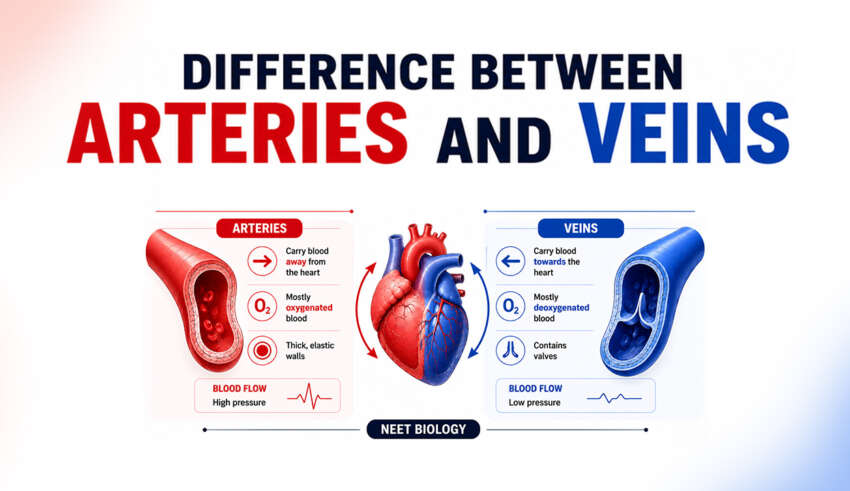
Arteries are the blood vessels that carry blood away from the heart. That blood is primarily oxygenated; it has just acquired oxygen from the lungs and now must transport it throughout the whole body.
The physical characteristics of arteries that make them unique are the thickness and strength of the walls. The heart forces the blood into them with a great deal of force, so the walls must be able to cope with that pressure without bursting. The biggest artery in the body is the aorta. It comes straight out of the left side of the heart and divides out into smaller and smaller arteries which run to your brain, your organs, your arms, your legs, everywhere.
One thing you will notice about arteries: you cannot really see them. They sit deeper in the body, protected, because the blood inside them is under high pressure and very important.
Check Out: Most Easy and Scoring Chapters for NEET 2026 Exam in Physics, Chemistry & Biology
Types of Arteries
There are three main types of arteries, each with a slightly different job:
- Elastic Arteries: Also called conducting arteries. These are the large ones; the aorta is the best example. They can expand along with the blood being pumped in during each pulse, and then contract again to get the blood flowing. It is this stretching that you feel in your pulse.
- Muscular Arteries: These are medium sized arteries that carry blood supplied by the elastic arteries to certain body parts. Good examples are the brachial artery in your arm and the femoral artery in your leg. Their walls carry more muscle and this means that they have better control of blood flow.
- Arterioles: The smallest type of artery. Imagine them as the last point of entry before the blood flows into the small capillaries. They assist in the regulation of the amount of blood that reaches a specific region and contribute significantly to the regulation of the blood pressure in a particular region.
Check Out: How to Prepare for NEET Exam 2026? NEET-UG Preparation Tips, Important Topics
What Are Veins?
Veins help in transporting the blood back to the heart. By the time (race against time phrase meaning) blood reaches the veins, it has already dropped off its oxygen to the body’s tissues, so it is mostly deoxygenated at this point.
Veins have thinner, softer walls than arteries. That makes sense, the blood pressure inside them is much lower. But thinner walls create a problem: blood can easily slow down or even flow backwards, especially in your legs, where it has to travel up against gravity. That is why veins have one-way valves inside them. These valves open when blood is moving toward the heart and close quickly to stop it from slipping back. When you walk or move around, your leg muscles squeeze the veins gently, pushing blood upward, and the valves hold it in place.
The largest veins in the body are the superior and inferior vena cava. The superior vena cava brings blood from your head, neck, and arms. The inferior vena cava handles blood from everything below the abdomen, legs, and lower body. Both empty into the right side of the heart.
Check Out: Best Offline & Online Study Material for NEET 2026 Exam Preparation
Types of Veins
The types of veins are a little more varied than most students expect:
- Pulmonary Veins: This is the big exception. While most veins carry deoxygenated blood, the four pulmonary veins carry oxygen-rich blood from the lungs back to the heart’s left atrium. Remember this, it comes up in exams constantly.
- Systemic Veins: These are the regular veins that pick up used, deoxygenated blood from the body’s tissues and return it to the heart.
- Deep Veins: Found inside the muscles, running alongside their artery counterpart. Most of your blood’s return journey happens through these.
- Superficial Veins: These are located immediately below the skin. They are the ones that you can occasionally find on the back of your hand, or in the inside of your forearm. Physicians and nurses like them to have blood drawn as they are easier to access and less painful.
Difference Between Arteries and Veins – At a Glance
Below is the comparison table of the main differences between arteries and veins:
| Feature | Arteries | Veins |
| Blood direction | Away from the heart | Toward the heart |
| Oxygen content (usually) | Oxygenated | Deoxygenated |
| Wall thickness | Thick and muscular | Thin and flexible |
| Blood pressure | High | Low |
| Valves | Not present | Present |
| Location in body | Deeper inside the body | Closer to the skin |
| Blood flow speed | Fast, pulsating | Slow and steady |
| When cut | Blood spurts out with force | Blood flows out slowly |
| Largest example | Aorta | Inferior vena cava |
Student Insight: The pulmonary artery carries deoxygenated blood, and the pulmonary vein carries oxygenated blood. This is the opposite of what arteries and veins normally do. It trips up a lot of students in NEET. Do not let it trip you up.
Check Out: Best Books for NEET Biology Preparation Suggested by Experts and Toppers
Similarities Between Arteries and Veins
Most students spend all their energy on the differences. But the similarities between arteries and veins are just as important, especially when a question asks you to compare rather than contrast.
- Both are part of the body’s circulatory system and keep blood moving around the clock.
- They are both of the same wall structure, three layers, with tunica intima on the inside, tunica media in the middle, and tunica adventitia on the outside.
- They are both lined on the inside by the endothelial cells, which ensure that the surface is smooth, so the clotting of blood against the walls does not occur.
- They both contain blood composed of the same elements: red blood cells, white blood cells, platelets, and plasma.
- Their walls contain smooth muscle which allows them to either tighten or loosen depending on what the body requires.
- They are both flexible enough to accommodate a change in blood volume and pressure; they are not hard tubes.
- Both assist the body to ensure it is at homeostasis, that is, they are involved in ensuring that the internal environment is stable, whether it is the delivery of oxygen to the body or maintaining a stable temperature in the body.
Structure of Arteries and Veins: The Three Layers
The structure of arteries and veins is an area that examiners are fond of testing. Both vessel types have the same three-layered design, the only difference being the thickness of each layer:
- Tunica Intima (Inner layer): This is the smooth inner lining. It is only a single cell thick and is in direct contact with the blood. This is also the layer in the veins where the one-way valves are developed.
- Tunica Media (Middle layer): This is where the biggest difference shows up. In arteries, this layer is thick with muscle and elastic fibres; it needs to be, to handle the high pressure. In veins, this layer is noticeably thinner.
- Tunica Adventitia (Outer layer): Made mainly of collagen. It is the outer covering that protects the vessel and binds it to the tissue around it.
Blood Pressure in Arteries and Veins: Why It Differs So Much
Blood pressure is one of the clearest ways to see the difference between arteries and veins. In a healthy adult, arterial blood pressure sits around 120/80 mmHg. Venous pressure is far lower usually between 5 and 10 mmHg. That is a massive gap.
Arteries get hit with a surge of blood every time the heart beats. Their thick walls absorb that pressure and keep the vessel intact. Veins, however, never feel such a force. They use the movement of muscles, the position of the body, and their valves to make the blood go back to the heart. It is also what makes your legs feel heavy when you stand still too long; the veins are working even harder without the assistance of muscle movement.
Exam Tip: If NEET asks which blood vessel has the highest blood pressure, it is the aorta. The lowest? The vena cava. These two answers cover a lot of MCQs on this topic.
Pulmonary and Systemic Circulation – How Arteries and Veins Fit In
Blood in your body takes two separate routes, and arteries and veins work in both:
- Pulmonary Circulation: The pulmonary artery takes deoxygenated blood from the heart to the lungs. The pulmonary veins bring oxygen-loaded blood back. This is generally a short loop that is focused.
- Systemic Circulation: Systemic arteries carry blood pumped by the heart out to all parts of the body. The used blood is collected by the systemic veins and is brought back. This is the long loop, touching the entire body.
Real Conditions That Affect Functioning Of Arteries and Veins
Knowing the functions of arteries and veins also helps you make sense of health conditions you come across in questions and in real life:
- Atherosclerosis: Over time, fatty deposits accumulate in the inner lining of the arteries, thus making them narrower. There is also less blood passing through, and it increases the chances of a heart attack or stroke. This occurs in arteries, not veins, due to the high-pressure environment.
- Varicose Veins: Blood does not move upwards as a result of the failure of the valves located within the superficial veins. The vein walls weaken and bulge outward; those are varicose veins. They show up in the legs for the simple reason that gravity is pulling blood downward there.
- Deep Vein Thrombosis (DVT): A blood clot develops within a deep vein, most often in the leg. When the clot detaches and moves to the lungs, it turns into a pulmonary embolism which is a severe medical emergency.
Conclusion
The difference between arteries and veins is not merely a point; it is an entire set of characteristics that indicate what each vessel is made to do. Arteries are built tough because they carry high-pressure blood. The veins are designed to be broad and with valves since they must run large amounts of blood at low pressure.
Meanwhile, the similarities between the arteries and the veins demonstrate that the vessels are heading in the same direction and, as a result, the blood will flow through your body in any case.
Whether you are studying Class 10 boards or are preparing to take (take with a grain of salt idiom synonym) NEET 2026, getting the types of arteries and veins correct, understanding their structures, and knowing the blood pressure values will help you stand out. This is one of those topics where a solid understanding is worth far more than surface-level memorisation.
| Explore NEET Biology Differences: Important Links | |
| Difference Between Prokaryotic and Eukaryotic Cells: Plant vs Animal Cell & Unicellular vs Multicellular Organisms | Difference Between Plant Cell and Animal Cell in Biology: Notes, Table & Diagram for NEET |
| Difference Between Arteries and Veins: Types, Functions & Similarities Explained | Difference Between Mitosis and Meiosis Cell Division, Key Differences & Comparison Table |
| Difference Between Biotic and Abiotic Factors in an Ecosystem | Difference Between Biology and Biotechnology |
| Difference between Osmosis and Diffusion | Difference Between Disinfection and Sterilization |
| Difference Between Fragmentation and Regeneration | Difference Between Flora and Fauna |
| Difference Between Breathing and Respiration | Difference Between Sympathetic And Parasympathetic |
| Difference Between Self-Pollination and Cross-Pollination | Difference between Nucleotide and Nucleoside |
| Difference between Bone and Cartilage | Difference Between Blood and Lymph |
| Difference Between Dicot And Monocot Roots | Difference Between Ligaments and Tendons |
| Difference between Endocrine and Exocrine Glands | Difference Between Active and Passive Immunity |
| Difference between the Cell Wall and the Cell Membrane | Difference Between Globular and Fibrous Protein |
| Difference Between Antibody and Antigen | Difference Between Moth and Butterfly |
| Difference between Serum and Plasma | Difference Between Food Chain And Food Web |
| Difference between Active and Passive Transport | Difference between Unicellular and Multicellular Organisms |
| Difference Between Pollination and Fertilization | Difference Between C3 And C4 Plants |
| Difference between Sexual and Asexual Reproduction | Difference Between Wildlife Sanctuary and National Park |
| Difference Between Spermatogenesis and Oogenesis | Difference Between Heart Rate and Pulse Rate |
| Difference between Herbs and Shrubs | Difference Between RBC And WBC |
| Difference Between Leopard and Cheetah | Difference between Leopard and Jaguar |
| Difference between Turtle and Tortoise | Difference Between Cerebellum and Cerebrum |
| Difference Between Diabetes Mellitus And Diabetes Insipidus | Difference Between Enzymes and Hormones |
Frequently Asked Questions (FAQs)
Q1. What is the main difference between arteries and veins?
Arteries transport blood outside of the heart and they work under high pressure. Veins are low-pressure blood vessels that take blood back to the heart and contain valves to stop backflow. The walls of the arteries are thick; the walls of the veins are thin and elastic.
Q2. Are there any arteries that do not always have oxygenated blood?
Typically, yes; however, not always. The deoxygenated blood is transported to the lungs by the pulmonary artery. And the pulmonary veins bring the blood, when it is oxygenated, back. These are the most frequently tested exceptions as far as the arteries and veins are concerned.
Q3. What are the primary types of arteries and veins?
There are three types of arteries: elastic arteries, muscular arteries and arterioles. Pulmonary veins, systemic veins, deep veins, and superficial veins are the main types of veins.
Q4. Why are there valves in the veins and not in the arteries?
Veins circulate the blood to the heart, often against gravity. In the absence of valves, blood would stagnate or flow backwards. The valves are not necessary in the arteries since the pumping force of the heart is so high that it can force the blood to move in a single direction.
Q5. Why do veins look blue through the skin?
They are not actually blue. All blood is red brighter when oxygenated, darker when not. The blue look comes from the way skin absorbs and scatters different wavelengths of light. Red light gets absorbed before reaching deep veins; blue light bounces back to your eyes.
Q6. What are the largest artery and vein in the human body?
The largest artery is the aorta. The largest vein is the inferior vena cava, which gathers the blood throughout the lower half of the body and returns it to the heart.
Q7. What occurs when an artery or vein is cut?
When an artery is cut, the blood exits at a high rate and force due to the high internal pressure. When a vein is cut, blood will flow out slowly and have more time to clot. That is why the wounds of the arteries are more urgent.
Written By: Saumya Sarin (Content Writer at Motion Education)
Reviewed By: Senior NEET Faculty (Motion Education)
Last Updated: June, 2026