Your blood flows in your veins, your bones keep your body upright, and your skin does not tear while stretching. These three things seem very different, but they are all forms of connective tissue. Most students are surprised when they first hear that blood is a connective tissue. It sounds wrong. But once you understand what connective tissue actually is, it makes a lot of NEET questions much easier.
In Class 11, connective tissue is taught as one of the four fundamental types of animal tissue alongside epithelial, muscular, and nervous tissue. This is the most common tissue distributed in the body, as it performs all the functions such as structural support and transportation of oxygen. Questions related to connective tissues for NEET exam are asked almost every year, usually testing classification, specific examples, and the concept of fluid matrix.
This guide will help you understand the different types of connective tissues, their functions, where they are located, and concepts related to them that students must know.
Read More: NEET Biology Syllabus 2026 – Botany, Zoology Important Topics of Biology Syllabus
What Is Connective Tissue? – Definition and Key Characteristics
Definition
Connective tissue is a type of animal tissue that connects, supports, and binds other tissues and organs. It is marked by the presence of cells in a large extracellular matrix (ECM), a non-living structure enwrapping cells and giving the tissue its desired properties.
Unlike epithelial tissue, where cells are tightly packed, connective tissue has cells that sit far apart from each other. What fills the space between them is the extracellular matrix, a gel-like or fluid material made of fibres and ground substance.
Here is something most textbooks list but rarely explain well: the ECM is not just (just in case definition) filler. It actually determines the properties of the connective tissue. Cartilage is firm because its ECM has a lot of collagen fibres. Blood as connective tissue is liquid because its ECM, called plasma, is a fluid. Bone is hard because its ECM is calcified. So when you understand the ECM, you understand the whole tissue.
Check Out: Most Easy and Scoring Chapters for NEET 2026 Exam in Physics, Chemistry & Biology
Components of Connective Tissue
Every connective tissue has three basic components:
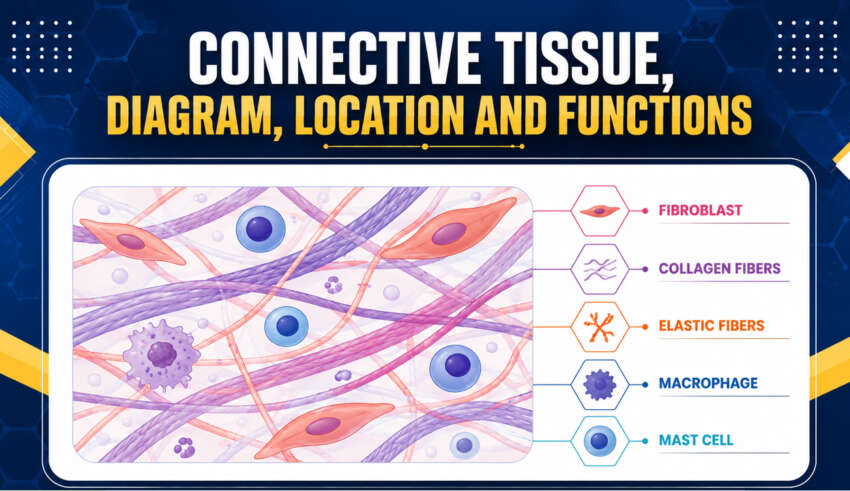
- Cells: Fibroblasts (most common), mast cells, macrophages, adipocytes, and, in specialised CT, osteocytes, chondrocytes, and blood cells
- Fibres: Collagen fibres (strength), elastin fibres (flexibility), reticular fibres (fine support networks)
- Ground Substance: The gel-like material between cells and fibres is part of the ECM
Together, these form the extracellular matrix of connective tissue that defines each subtype. Connective tissue originates from the mesoderm, the middle embryonic layer. This is a NEET-relevant fact that often appears as an MCQ.
Types of Connective Tissue – Complete Classification
There are how many types of connective tissues found in the human body? Majorly, there are three types of connective tissues: Loose Connective Tissue, another is Dense Connective Tissue, and the third is Specialised Connective Tissue. Each has subtypes. Understanding all of them is essential both for Class 11 exams and NEET preparation. Let us go through each one with its description, location, and function.
| Type | Subtype / Example | Location in Body | NEET Tip |
| Loose CT | Areolar | Under skin, around organs | Most widely distributed loose CT |
| Loose CT | Adipose | Below the skin, around the kidneys | Stores fat; insulation |
| Loose CT | Reticular | Lymph nodes, spleen | Forms a mesh-like framework |
| Dense CT | Dense Regular (Tendons) | Muscle to bone | Parallel collagen fibres |
| Dense CT | Dense Irregular (Dermis) | Deep layer of skin | Fibres in all directions |
| Dense CT | Elastic (Ligaments) | Bone to bone at joints | High elastin content |
| Specialised CT | Bone | Skeleton | Calcified ECM = hardness |
| Specialised CT | Cartilage | Nose, ear, joints | Avascular – no blood supply |
| Specialised CT | Blood | Heart and blood vessels | Plasma = liquid ECM |
| Specialised CT | Lymph | Lymphatic vessels | Carries WBCs and proteins |
Check Out: Effective Tips to Clear Backlogs in NEET 2026
Examples of Loose Connective Tissue
1. Areolar Connective Tissue
Areolar connective tissue is the most widely distributed connective tissue in the body. It fills the spaces between organs, wraps around blood vessels and nerves, and forms the layer just below the skin. It contains all three fibre types: collagen, elastin, and reticular and all the major cell types, including fibroblasts and mast cells. Think of it as the body’s general-purpose packing material.
2. Adipose Connective Tissue
Adipose tissue is specialised for fat storage. It is found underneath the skin and around the kidneys, where it is used to provide thermal insulation, cushioning organs, as well as providing a long-term energy source to the body.
3. Reticular Connective Tissue
A fine mesh-like structure is made up of reticular tissue. It can be found in the lymph nodes, spleen and bone marrow, where it is involved in blood cell development and provides scaffolding structures to the immune organs.
Check Out: How to Make Short Notes for NEET Exam 2026: Smart Tips to Boost Your Score
Examples of Dense Connective Tissue
1. Dense Regular Connective Tissue (Tendons)
Dense regular CT contains parallel collagen fibres tightly packed, giving it immeasurable tensile strength. This tissue is used to make tendons, which connect muscles to bones and efficiently transmit movement forces.
2. Dense Irregular Connective Tissue
Dense irregular CT contains collagen fibres, which are oriented in more than one direction making it resistant to being stretched in any direction. It composes the dermis of the skin and the capsules that enclose the organs and joints.
3. Elastic Connective Tissue (Ligaments)
The Elastic connective tissue is rich in elastin fibres. This fibre allows them to stretch and recoil. The ligaments are made from this tissue that helps in connecting bone to bone at joints and helps in maintaining stability during movement.
Examples of Specialised Connective Tissue
1. Bone
Bone is a specialised connective tissue whose ECM is composed of calcium, making it very hard. It shapes the skeleton, shields organs, bears the weight of the body, and it is where blood cells are made.
2. Cartilage
Cartilage is firm yet flexible specialised CT. Found at joints, nose tip, trachea rings, and ear pinna, it reduces friction between bones. It is avascular, with no blood vessels, so it heals very slowly.
3. Blood
Blood as connective tissue has a liquid ECM called plasma. It is located in the heart and blood vessels and it carries oxygen, nutrients, hormones, and waste, linking all the organ systems in the body.
4. Lymph
Lymph is a colourless fluid connective tissue flowing through lymphatic vessels. It takes out the excess fluid from the tissues, carries with it white blood cells and contributes a major part in immune defence.
NEET Memory Hook – The 3 L Rule
The NEET questions based on connective tissues revolve around these three categories: Loose, Laminated (Dense), or Liquid (Blood & Lymph). Before answering any CT-related MCQ, first identify which L the tissue belongs to. That alone will eliminate two or three wrong options instantly.
Check Out: Most Repeated Questions in NEET Exam for 2026: Check Key Topics to Score High
Functions of Connective Tissue and Location in the Body
The functions of connective tissue go far beyond just binding organs together. They all have different purposes, and knowing the relationship between function and localisation of connective tissue in the body is precisely what the NEET MCQs exams test.
- Structural support: Bone and cartilage support the body structure. The rigidity of bone is due to the deposition of calcium phosphate in the bone ECM. Cartilage is tough yet flexible; it is also avascular (that is, it has no direct blood supply), which explains why cartilage injuries heal very slowly.
- Binding and connecting: Tendons attach muscles to bones; ligaments attach bones at joints. Both these tasks are performed by dense connective tissue with its strongly packed collagen fibres.
- Insulation and energy storage: Adipose tissue (fat) under the skin acts as both thermal insulation and an energy reserve. It also cushions organs like the kidneys.
- Immune defence: Lymphoid tissue and the lymph system carry white blood cells. Mast cells in the areolar tissue release histamine during allergic reactions, a connective tissue cell doing immune work.
- Transport: Blood is the most important transport tissue in the body oxygen, nutrients, hormones, waste all moved by this liquid connective tissue through its plasma ECM.
Why Is Blood a Connective Tissue? – A Common NEET Confusion
Given below are the three main reasons why blood is considered a connective tissue. Students should know them as they can be asked in the NEET exam.
- Embryonic origin: Blood is developed from mesoderm, the same as all other connective tissues.
- ECM structure: Blood has a liquid extracellular matrix called plasma. The cells, red blood cells (RBCs), white blood cells (WBCs), and platelets are suspended in this plasma in the same way that the connective tissue cells are suspended in their ECM.
- Connecting function: Blood connects every tissue and organ by transporting materials throughout the body, which is the defining function of connective tissue.
Most students wrongly assume that blood as connective tissue, does not fit because it is liquid. But the liquid state comes from its ECM (plasma), not from its classification. Once you see it that way, it clicks permanently.
Exam Alert – NEET MCQ Patterns on Connective Tissue
NEET 2019 asked: ‘Which of the following is not a connective tissue?’ Options included cartilage, blood, and epithelium (the answer was epithelium). In the NEET 2021 exam, the ECM concept was directly asked. Watch out for questions that ask ‘what is the matrix of blood called’ (answer was Plasma) and ‘which connective tissue lacks blood supply’ (answer was Cartilage avascular).
Download: NEET Previous Year Question Papers with Solutions – Free PDF Download
Types of Cartilage – What Most Blogs Miss
Cartilage is a subtype of specialised connective tissue. It has three types, all tested in NEET. This is one of those connective tissue Class 11 topics that most blogs skim over, but where marks are quietly lost in the exam.
| Type | Key Property | Location | NEET Note |
| Hyaline Cartilage | Smooth, glassy surface | Joints, nose tip, trachea rings | Most common type |
| Fibrocartilage | Very tough, compressible | Intervertebral discs, knee meniscus | Highest collagen content |
| Elastic Cartilage | Flexible, springy | Ear pinna, epiglottis | Rich in elastin fibres |
One fact that rarely appears in student notes: all cartilage is avascular (no blood vessels inside it). Nutrients reach chondrocytes, the cartilage cells, by diffusion through the ECM. This is why cartilage repairs so slowly after injury, and why athletes with torn menisci often need surgery rather than just rest, which is a standard MCQ point in NEET.
Tendons vs. Ligaments – A Classic NEET Confusion
From this topic dense connective tissue are generally asked. The table below shows all you need to remember:
| Feature | Tendon | Ligament |
| Connects | Muscle to bone | Bone to bone |
| CT Type | Dense regular (collagen) | Dense elastic (elastin) |
| Flexibility | Low firm and strong | Higher — slightly elastic |
| Example | Achilles tendon | Knee joint ligaments |
Connective Tissue Disorders – A Real-World Connection
Understanding connective tissue is not just exam theory. It has direct clinical meaning:
- Scurvy: Caused by Vitamin C deficiency. Vitamin C plays a crucial role in the synthesis of collagen, the major structural protein in connective tissue. In its absence, blood vessels become weak, gums bleed, and wounds do not heal. Scurvy is simply a breakdown in the maintenance of connective tissue.
- Marfan Syndrome: A genetic disorder where fibrillin, important for elastin fibre structure, is defective. People with Marfan syndrome have hypermobile joints and are at risk of aortic rupture, all because their connective tissue is structurally compromised.
These examples tell us why ECM and its composition are important to understand in general.
Quick Revision – Last 60 Seconds Before the Exam
- All the connective tissues are developed from mesoderm
- Blood is a type of connective tissue, and plasma carries liquid ECM
- Cartilage is avascular tissue because blood vessels are not present in it.
- A tendon joins a muscle to a bone, and a ligament connects bone to bone
- Areolar tissue is known as the most widely distributed loose CT
- Adipose tissue helps in fat storage and provides insulation
Frequently Asked Questions
Q1. What are the different types of connective tissue and their functions?
There are three broad types of connective tissue: Loose CT (areolar, adipose, reticular fills spaces, stores fat, supports immune cells), Dense CT (tendons, ligaments provide structural strength and joint stability) and Specialised CT (blood, lymph, bone, cartilage transport, support, protection). All types of connective tissues are divided on the basis of extracellular matrix structure.
Q2. Why blood is called connective tissue?
Blood qualifies as connective tissue for three reasons: it originates from the mesoderm, it has a liquid extracellular matrix called plasma in which cells are suspended, and it functionally connects all tissues by transporting substances throughout the body. That blood is liquid does not exclude that plasma is simply a fluid form of ECM.
Q3. How many types of connective tissue are there?
There are three major categories: Loose, Dense, and Specialised, with about 10 distinct subtypes in total: areolar, adipose, reticular, dense regular, dense irregular, elastic, bone, the three types of cartilage, blood, and lymph. To answer connective tissue NEET questions, it is enough to know these three categories and important examples to answer most MCQs.
Q4. Where are connective tissues located in the body?
The location of the connective tissues present in the body differs according to their types. Areolar tissue is located under the skin and surrounding the organs; adipose tissue is found under the skin and around the kidneys; tendons are at the muscle-bone junctions; cartilage lines joints and forms the trachea; bone is made up of the skeleton; and blood circulates in the whole vascular system.
Q5. What are examples of connective tissues in the NEET exam?
Important connective tissue examples for NEET are: Blood (liquid CT, plasma = ECM), Bone (calcified ECM), Hyaline Cartilage (at joints and trachea), Areolar connective tissue (most common loose CT), Tendon (dense regular CT), Adipose tissue (fat storage). A frequently asked NEET MCQ type: ‘Which is not a connective tissue?’ The answer is always epithelial, muscular, or nervous tissue.
Putting It All Together
Connective tissue is not a single thing; it is a family of tissues that connect, support, store, protect, and transport. The one concept that ties all types of connective tissue together is the extracellular matrix. Change the ECM, and you change the tissue completely from fluid blood to rigid bone, from cushioning fat to strong tendons.
For NEET and Class 11 exams, focus on the ECM concept, the blood-as-CT reasoning, the tendon-ligament distinction, and the three cartilage types. You can best remember the functions of connective tissue by linking each type to what its ECM is made of and where it is found in the body.
You have covered the full topic today, from definition to real-world disorders. The student who understands connective tissue conceptually will always outperform the one who only memorised the list. Explore more Biology notes and concept guides on the Motion Education website.
Author: Saumya Sarin (Content Writer at Motion Education)
Reviewed By: Senior NEET Faculty – Motion Education
Last Updated: May, 2026