What Are Cells? The Foundation of All Living Organisms
One of the most important topics in class 11 biology is the difference between prokaryotic and eukaryotic cells and as you are preparing for NEET exam 2027, this topic will appear again and again. But this is something most students fail to grasp; it’s not merely memorising a table. It’s about knowing what that difference means and how that reflects the evolution of life on Earth.
From the bacteria that live in your gut to the tree outside the window, everything living, be it a human or a plant, is composed of cells. However, not all cells are created equal. Some are simple, ancient and small. Others are complex, large and compartmentalised.
This one structural difference, the presence or absence of a true nucleus, divides all life into just (just in case definition) two groups. That is what prokaryotic cell vs eukaryotic cell really means. In this blog, you will get a clear breakdown of both cell types, a detailed comparison table with a column that explains why each difference matters, and brief overviews of unicellular vs multicellular organisms and plant cell vs animal cell topics that NEET loves to link together.
Read More:
- Most Scoring Units & Chapters in Biology That Cover 60% of NEET 2026 Biology Paper
- Difference Between Mitosis and Meiosis Cell Division, Key Differences & Comparison Table
Prokaryotic and Eukaryotic Cells: Definition, Structure, and Core Differences
What Are Prokaryotic Cells?
Prokaryotic cells are the oldest type of cell on the planet. The name comes from the Greek “pro”, which means before, and “karyon” means nucleus. So prokaryotes literally means “before the nucleus” These are cells that existed and thrived long before a true, enclosed nucleus ever evolved.
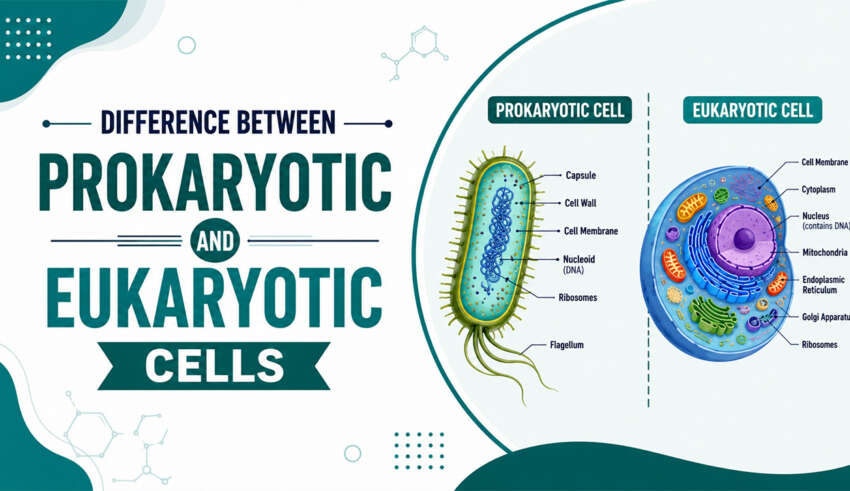
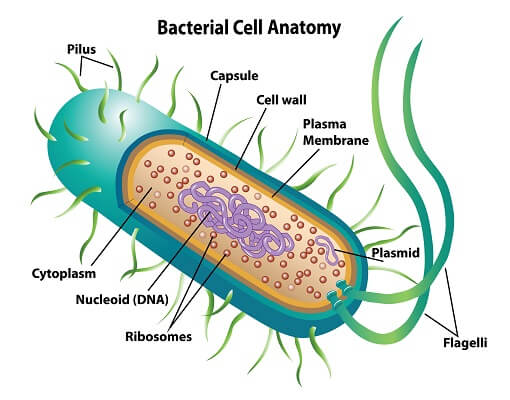
The single most important thing about prokaryotic cell structure is this: there is no membrane-bound nucleus. The genetic material, a circular strand of DNA, just floats freely in a region called the nucleoid. There is no membrane around it, no protective envelope, nothing. It is just DNA in the cytoplasm.
Key features of prokaryotic cell structure:
- No membrane-bound nucleus, DNA lies in the nucleoid region
- Ribosomes are 70S type (50S + 30S subunits) – this is extremely important for NEET
- Cell wall is present and is made of peptidoglycan (murein) in bacteria
- No membrane-bound organelles, no mitochondria, no ER, no Golgi apparatus
- Mesosome presents an infolding of the plasma membrane that compensates for the absence of mitochondria
- Plasmids present small circular DNA fragments separate from the main chromosome; they often carry antibiotic resistance genes
- Cell division by binary fission – no mitosis, no meiosis, just one cell splitting into two
Prokaryotic cell examples: Bacteria (E. coli, Staphylococcus), Archaea (Methanobacterium), Cyanobacteria (Nostoc, Anabaena)
NEET Tip: Nostoc is a cyanobacterium, which makes it a prokaryote. A lot of students assume it is an alga (algae are eukaryotic), but it is not. Whenever NEET asks “which of the following is a prokaryote,” Nostoc is almost always the right answer.
Check Out: Ribosomes Functions, Structure, Location, Types for NEET
What Are Eukaryotic Cells?
The structure of eukaryotic cells is much more advanced. The prefix “eu” means “true”, and “karyon” means “nucleus”, so in “eukaryotes” the word “eu” indicates that the nucleus is true and enclosed in a membrane. The key difference between prokaryotic and eukaryotic cells is in terms of their structural organisation. The DNA in this nucleus is linear (not circular) and organised into several chromosomes, and wrapped by special proteins called histones.
Why does that matter? Because histone proteins allow the DNA to be tightly packed and also play a huge role in controlling which genes are switched on or off. This kind of gene regulation is just not possible in prokaryotes, and it is part of why eukaryotic organisms can become so incredibly complex.
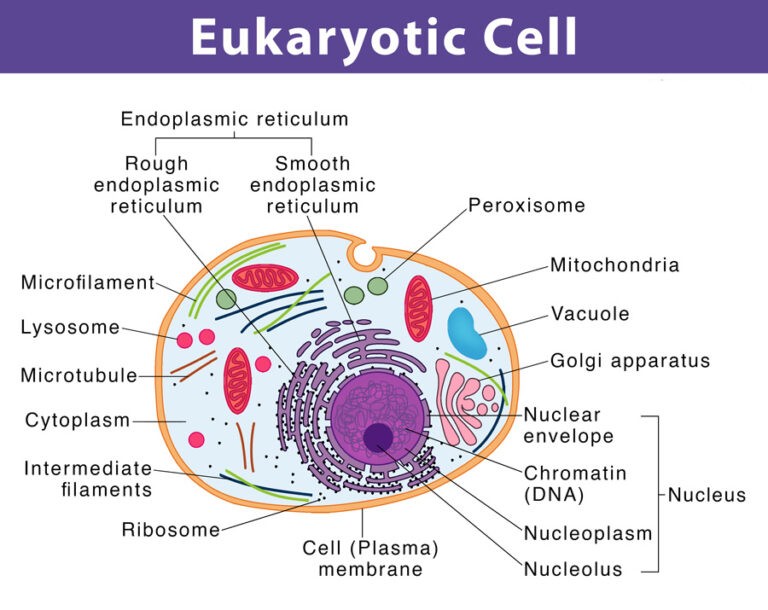
Eukaryotic cells also come with a full set of membrane-bound organelles. Each organelle is like a tiny room inside the cell, sealed off, specialised, and doing a very specific job. Mitochondria produce energy, the ER builds proteins and lipids, the Golgi sorts and packages things, and lysosomes break down waste. This internal organisation is what allows eukaryotic cells to be so versatile.
Key features of eukaryotic cell structure:
- Well-defined nucleus with nuclear membrane (double membrane with nuclear pores)
- Ribosomes are 80S type (60S + 40S subunits)
- Membrane-bound organelles – mitochondria, ER (rough + smooth), Golgi apparatus, lysosomes, peroxisomes
- Linear DNA is associated with histone proteins, and more complex gene regulation is possible
- Cell division by mitosis (body cells) or meiosis (reproductive cells)
- Cell wall present in plants (cellulose) and fungi (chitin) is absent in animal cells
Eukaryotic cell examples: Amoeba, Paramecium, all plant cells, all animal cells, fungi, Euglena
Interesting fact: The ribosomes inside mitochondria and chloroplasts are 70S, just like prokaryotes. This is not a coincidence. It is the basis of the endosymbiotic theory, which proposes that these organelles were once free-living prokaryotes that got absorbed by larger cells. NEET has directly asked about this, so do not skip it.
Download: NEET 2026 Sample Papers with Solutions (Latest Exam Pattern) – Free PDF
Difference Between Prokaryotic and Eukaryotic Cells – Detailed Comparison Table
Here is the full comparison. Explaining why each difference matters because understanding the “why” helps you retain the fact much better, and sometimes NTA frames questions around the significance, not just the difference in NEET exam.
| # | Parameter | Prokaryotic Cell | Eukaryotic Cell | Why It Matters (NEET) |
| 1 | Nucleus | Absent DNA lies in the nucleoid region | Present enclosed within a double nuclear membrane | The most fundamental difference between the two directly defines their names |
| 2 | Cell Size | 1-10 µm (very small) | 10–100 µm (much larger) | Larger size allows room for multiple complex organelles |
| 3 | DNA Structure | Circular, naked, no histone proteins | Linear chromosomes wrapped around histone proteins | Histone association allows better gene regulation and packing in eukaryotes |
| 4 | Nuclear Membrane | Absent an envelope around the DNA | Present a double membrane with nuclear pores | Nuclear pores control what enters/exits the nucleus in eukaryotes |
| 5 | Ribosomes | 70S type (50S + 30S subunits) | 80S type (60S + 40S subunits) | This difference is the basis for antibiotic drugs that target 70S without harming human cells. |
| 6 | Mitochondria | Absent mesosome acts as a functional substitute | The present site (idiom site) of aerobic respiration | Prokaryotes do not have mitochondria; the mesosome is a plasma membrane infolding. |
| 7 | Endoplasmic Reticulum | Absent | Present (rough + smooth ER) | ER is critical for protein synthesis and lipid metabolism in eukaryotes |
| 8 | Golgi Apparatus | Absent | Present | Golgi packages and ships proteins; absent in prokaryotes |
| 9 | Cell Wall | Present peptidoglycan (murein) in bacteria | Plants: cellulose; Fungi: chitin; Animal cells: absent | Cell wall composition differs. This is a classic NEET MCQ point. |
| 10 | Cell Division | Binary fission simple and fast | Mitosis (somatic) / Meiosis (reproductive) | Prokaryotes skip spindle formation entirely; eukaryotes need it |
| 11 | Plasmids | Commonly present | Rare or absent | Plasmids carry medically important antibiotic resistance genes in bacteria. |
| 12 | Mesosome | Present infolding of the plasma membrane | Absent | The mesosome compensates for the absence of mitochondria in prokaryotes |
| 13 | Chromosome No. | Single circular chromosome | Multiple linear chromosomes | More chromosomes = more complex gene arrangements in eukaryotes |
| 14 | Nucleolus | Absent | Present inside the nucleus | The nucleolus makes rRNA needed for ribosome assembly |
| 15 | Membrane-Bound Organelles | None present | Mitochondria, ER, Golgi, lysosomes, etc. | Compartmentalisation is the hallmark of eukaryotic complexity. |
| 16 | Examples | E. coli, Nostoc, Methanobacterium, Staphylococcus | Amoeba, Paramecium, Fungi, all plant & animal cells | Nostoc is a frequent NEET trap. It is prokaryotic, not algae |
Similarities Between Prokaryotic and Eukaryotic Cells
Most study resources focus only on differences, but NEET has directly asked about similarities. So make sure you know these:
- Both are covered by a plasma membrane (cell membrane)
- Both contain DNA as their genetic material
- Both have ribosomes, though of different sizes (70S vs 80S)
- Both carry out the same basic life processes: metabolism, growth, reproduction, and response to the environment
- Both follow the same genetic code, the same codons code for the same amino acids in bacteria as in humans
Examples of Prokaryotic and Eukaryotic Organisms
A quick rule that works almost every time: if it is a bacterium or archaeon, it is a prokaryote. Everything else, animals, plants, fungi, protists, is eukaryotic. Here is a more detailed breakdown with features that NEET frequently tests:
| Category | Organism | Kingdom / Group | Key Feature |
| Prokaryote | Escherichia coli (E. coli) | Bacteria | Gram-negative rod; lives in the human gut; very commonly asked in NEET |
| Prokaryote | Nostoc | Cyanobacteria | Photosynthetic prokaryote; students mistake it for algae (eukaryotic) |
| Prokaryote | Methanobacterium | Archaea | Produces methane; found in extreme environments |
| Prokaryote | Staphylococcus | Bacteria | Gram-positive; causes skin infections |
| Eukaryote | Amoeba | Protist | Unicellular; moves using pseudopods |
| Eukaryote | Paramecium | Protist | Unicellular; moves using cilia; has two nuclei (macro + micro) |
| Eukaryote | Saccharomyces (Yeast) | Fungi | Unicellular fungus; used in fermentation |
| Eukaryote | Euglena | Protist | Has chloroplasts that can photosynthesise; also heterotrophic |
| Eukaryote | Human cell | Animal | Multicellular; 80S ribosomes; no cell wall |
How Cell Type Relates to Organism Complexity: Unicellular and Multicellular Overview
Once you understand the prokaryotic vs eukaryotic cell difference, the next logical question is: what does cell type have to do with how complex an organism can be? The answer to that brings us to unicellular and multicellular organisms.
Unicellular vs Multicellular Organisms: A Detailed Overview
Unicellular organisms are made of just one cell, and that single cell handles everything: nutrition, respiration, excretion, and reproduction. Multicellular organisms are made of many cells, each specialised for a specific job.
| Parameter | Unicellular | Multicellular | Example (Unicellular) | Example (Multicellular) |
| Cell Number | Single cell only | Millions to trillions of cells | Amoeba, Paramecium | Humans, Trees, Mushrooms |
| Cell Type | Prokaryotic or eukaryotic | Always eukaryotic | Bacteria (prok.), Yeast (euk.) | All plants and animals |
| Division of Labour | The absence of one cell does everything | Present cells specialise | E. coli handles its own respiration | Muscle cells, nerve cells, RBCs |
| Complexity | Structurally simple | Complex tissues, organs, systems | – | The human body has ~37 trillion cells. |
| Reproduction | Binary fission, budding, and spores | Sexual and asexual reproduction | Amoeba by binary fission | Humans: sexual; Hydra: budding |
| Response to Damage | A cell dies if damaged | Other cells can compensate | – | Liver cells regenerate after damage. |
| Lifespan | Often hours to days | Years to centuries | – | Giant sequoia trees: 3000+ years |
Plant Cell vs Animal Cell: What You Need to Know
Plant and animal cells are both eukaryotic and not alike. There are a few differences in structure that are tested frequently within NEET.
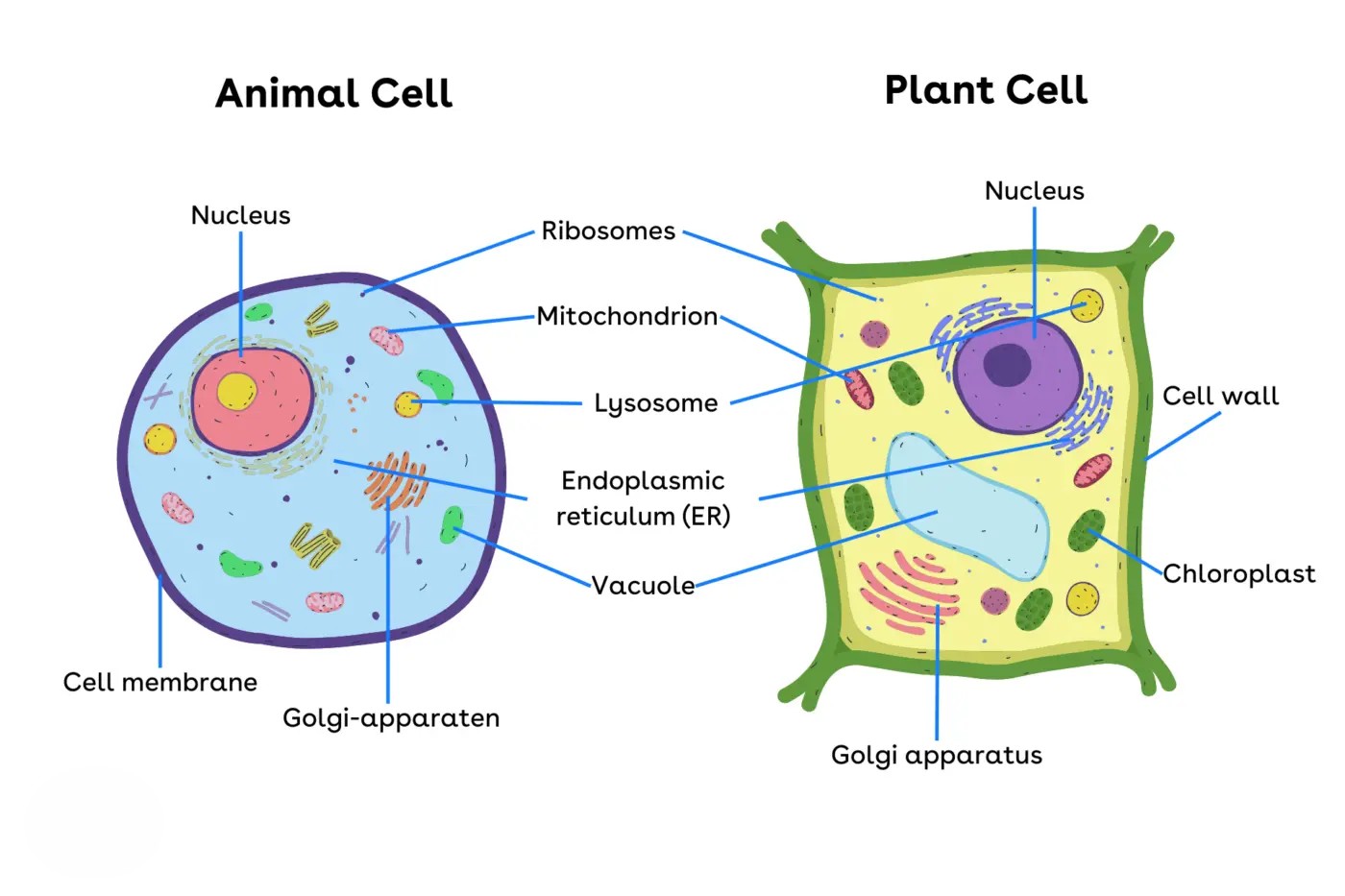
Plant Cell vs Animal Cell: Key Differences
| # | Parameter | Plant Cell | Animal Cell | Exam Tip |
| 1 | Cell Wall | Present rigid, made of cellulose | Absent flexible plasma membrane only | Cellulose cell wall = plant; chitin = fungi; peptidoglycan = bacteria |
| 2 | Chloroplasts | Present site of photosynthesis | Absent | Plants make their own food; animals cannot |
| 3 | Vacuole | Large central vacuole (stores water, maintains turgor) | Small or absent | Central vacuole collapses in wilting osmosis question |
| 4 | Centrioles | Absent in most plant cells | Present forms a spindle during division | Plants still divide, but they use other mechanisms for spindle formation |
| 5 | Lysosomes | Rare (vacuole takes over) | Common digest waste and foreign material | Lysosomes are the cell’s ‘garbage disposal’ |
| 6 | Energy Storage | Starch (glucose polymer) | Glycogen (glucose polymer) | Both are glucose polymers, but starch in plants, glycogen in animals |
| 7 | Shape | Fixed, rectangular (due to cell wall) | Irregular, flexible | The shape difference is visible under a microscope |
| 8 | Plasmodesmata | Present allows cell-to-cell communication | Absent (gap junctions instead) | Plasmodesmata = plant equivalent of animal gap junctions |
| 9 | Examples | Leaf mesophyll cell, onion epidermal cell | RBC, neuron, muscle cell, liver cell | RBC has no nucleus at maturity, a unique animal cell feature |
Check Out: NEET Previous Year Question Papers with Solutions – Free PDF Download
NEET-Pattern Practice Questions on Cell Structure and Classification
Here are five questions in the same format as the NEET questionnaire. See if you can do the same, then compare your answers and explanations.
| Q | Question | Answer | Explanation |
| Q1 | Which feature is NOT found in prokaryotic cells? (a) 70S ribosomes (b) Circular DNA (c) Membrane-bound nucleus (d) Mesosome | (c) | Prokaryotes do not have a nuclear membrane, instead DNA is free in the nucleoid region. |
| Q2 | Ribosomes of mitochondria are similar to: (a) 80S cytoplasmic (b) 70S prokaryotic (c) 60S subunit (d) Both 70S and 80S | (b) | Supports the endosymbiotic theory that mitochondria evolved from ancient prokaryotes. |
| Q3 | Which among the following is a prokaryote? (a) Amoeba (b) Paramecium (c) Nostoc (d) Euglena | (c) | Nostoc is a cyanobacterium, a prokaryote. The other three are eukaryotic protists. |
| Q4 | Cell wall in bacteria is made of: (a) Cellulose, (b) Chitin, (c) Peptidoglycan, (d) Sporopollenin | (c) | Peptidoglycan (murein) is unique to bacterial cell walls, a top NEET fact. |
| Q5 | In eukaryotic cells, DNA is: (a) Naked and circular, (b) Linear, with histone proteins, (c) in the nucleoid, (d) Single-stranded | (b) | Eukaryotic DNA is linear and wrapped around histones which are used to compact and regulate DNA. |
Quick Recap: Prokaryotic vs Eukaryotic Cells at a Glance
Before moving on, please note these key points:
- Prokaryotic cells: no true nucleus, 70S ribosomes, circular DNA, peptidoglycan cell wall, no membrane-bound organelles, binary fission
- Eukaryotic cells: true nucleus, 80S ribosomes, linear DNA with histones, full set of membrane-bound organelles, mitosis/meiosis
- Prokaryotic and eukaryotic cells for NEET: remember 70S vs 80S, mesosome in prokaryotes, nucleoid region, absence of membrane-bound organelles; these are the most tested points
- Cell wall in prokaryotes and eukaryotes: bacteria have peptidoglycan, plant cells have cellulose, fungal cells have chitin, animal cells have none
- Mitochondria and chloroplast ribosomes are 70S connects directly to the endosymbiotic theory
It is important to understand this comparison, as mentioned in the NCERT Biology 11 Chapter 8 The Unit of Life, which is the base of all cell biology, genetics, and evolution.
| Explore NEET Biology Differences: Important Links | |
| Difference Between Prokaryotic and Eukaryotic Cells: Plant vs Animal Cell & Unicellular vs Multicellular Organisms | Difference Between Plant Cell and Animal Cell in Biology: Notes, Table & Diagram for NEET |
| Difference Between Arteries and Veins: Types, Functions & Similarities Explained | Difference Between Mitosis and Meiosis Cell Division, Key Differences & Comparison Table |
| Difference Between Biotic and Abiotic Factors in an Ecosystem | Difference Between Biology and Biotechnology |
| Difference between Osmosis and Diffusion | Difference Between Disinfection and Sterilization |
| Difference Between Fragmentation and Regeneration | Difference Between Flora and Fauna |
| Difference Between Breathing and Respiration | Difference Between Sympathetic And Parasympathetic |
| Difference Between Self-Pollination and Cross-Pollination | Difference between Nucleotide and Nucleoside |
| Difference between Bone and Cartilage | Difference Between Blood and Lymph |
| Difference Between Dicot And Monocot Roots | Difference Between Ligaments and Tendons |
| Difference between Endocrine and Exocrine Glands | Difference Between Active and Passive Immunity |
| Difference between the Cell Wall and the Cell Membrane | Difference Between Globular and Fibrous Protein |
| Difference Between Antibody and Antigen | Difference Between Moth and Butterfly |
| Difference between Serum and Plasma | Difference Between Food Chain And Food Web |
| Difference between Active and Passive Transport | Difference between Unicellular and Multicellular Organisms |
| Difference Between Pollination and Fertilization | Difference Between C3 And C4 Plants |
| Difference between Sexual and Asexual Reproduction | Difference Between Wildlife Sanctuary and National Park |
| Difference Between Spermatogenesis and Oogenesis | Difference Between Heart Rate and Pulse Rate |
| Difference between Herbs and Shrubs | Difference Between RBC And WBC |
| Difference Between Leopard and Cheetah | Difference between Leopard and Jaguar |
| Difference between Turtle and Tortoise | Difference Between Cerebellum and Cerebrum |
| Difference Between Diabetes Mellitus And Diabetes Insipidus | Difference Between Enzymes and Hormones |
Frequently Asked Questions (FAQs)
Q1. What is the main difference between prokaryotic and eukaryotic cells?
The only difference is the nucleus. In a prokaryotic cell, the DNA is not surrounded by a membrane and resides in a nucleoid. In eukaryotic cells, the nucleus is surrounded by a nuclear membrane and is clearly defined.
Q2. Do prokaryotes have mitochondria?
No, Prokaryotes lack mitochondria and other membrane bound organelles. Rather they have mesosomes (infoldings of plasma membrane) where they carry out cellular respiration.
Q3. Is a bacterium prokaryotic or eukaryotic?
Bacteria are prokaryotic. They have circular DNA, 70S ribosomes, no nuclear membrane, and a peptidoglycan cell wall. Examples include E. coli, Staphylococcus, and Mycobacterium tuberculosis.
Q4. What are 70S and 80S ribosomes?
S stands for Svedberg unit, a measure of sedimentation rate. Prokaryotes have 70S ribosomes (made of 50S + 30S subunits). Eukaryotes have 80S ribosomes (60S + 40S). Importantly, mitochondria and chloroplast ribosomes are 70S, which supports the endosymbiotic theory.
Q5. Can a cell be both prokaryotic and eukaryotic?
An organism does not contain a cell that has both types. These are two completely different kinds of structures. Eukaryotic cells, however, do have organelles (mitochondria, chloroplasts) that contain the prokaryotic-like ribosomes, confirming their ancient evolutionary origins.
Q6. Which organisms have eukaryotic cells?
All plants, animals, fungi, and protists have eukaryotic cells. Examples: Amoeba, Paramecium, Euglena, yeast, all human cells, all leaf cells. Only bacteria and archaea are prokaryotic.
Written By: Saumya Sarin (Content Writer at Motion Education)
Reviewed By: Senior Biology NEET Faculty (Motion Education)
Last Updated: June, 2026