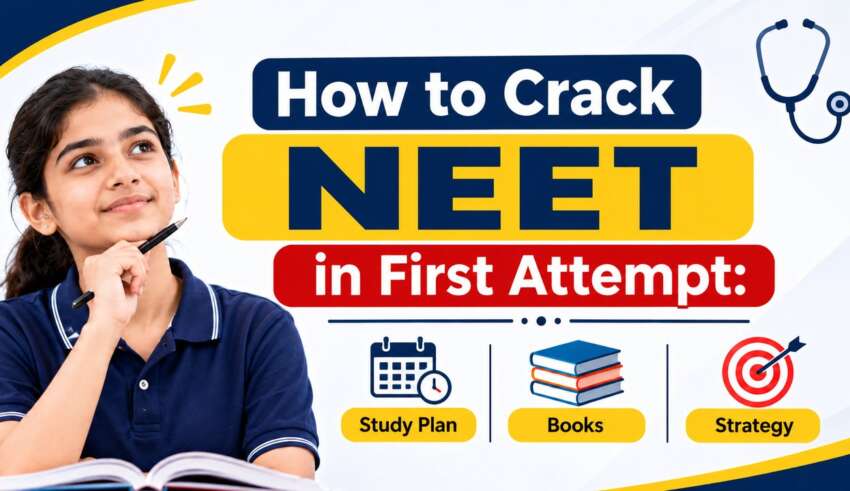
If you want to know how to crack NEET 2027 in first attempt, the answer is simple: it is possible with a proper approach, study techniques, subject-wise study plan and discipline. NEET, the National Eligibility cum Entrance Test, is a national-level exam for MBBS, BDS and AYUSH seats. In 2026, nearly 20 lakh students appeared for the exam and 11.21 lakh qualified. India has about 1.4 lakh MBBS seats, so the NEET selection rate is close to 7 percent. NTA has not shared the total first-attempt pass count. Still, over 93 percent of the 138 students who scored 690 or more were first-time takers.
For students to achieve their dream goal, in this blog we have explained how to clear NEET with the right syllabus plan, books, schedule and tests. Experienced Motion Education NEET faculty suggest every tip here.
Read More:
Can I Crack NEET in First Attempt?
Yes, it is possible to crack the NEET exam in first attempt and many students crack NEET exam on the first attempt every year. NTA data shows that over 93 percent of the 138 students who scored 690 or above were first-time takers. Nearly all were aged 17–19 years. The above data is based on the official data of the NEET UG 2026 result released by NTA and the NMC seat matrix for 2026-27. In total, 11.21 lakh out of 19.99 lakh students qualified, representing a success rate of NEET of almost 56 percent. Qualification in NEET does not guarantee admission. The NEET selection ratio is around 7 percent with approximately 1.4 lakh MBBS seats available. Therefore, students should try to receive a good grade.
A first attempt works when you build a clear NEET first attempt strategy. Know the exam pattern and syllabus, focus on high-weightage chapters, follow a study plan and test yourself every week. Many NEET preparation tips by toppers say the same things. They read NCERT line by line, solve previous year questions daily, take (take with a grain of salt idiom synonym) mocks often and revise every week. Follow these tips from today.
Tips to Clear the NEET 2027 Exam on First Attempt
Below are ten NEET first-attempt preparation tips that Experienced Motion faculty share with their students. Follow them in order for the best results. Each tip works best when you practise it daily.
Why Should You Understand the NEET Syllabus First?
Read the NEET Syllabus before you open any book, as it gives you the subject matter that you need to study. The latest syllabus has been approved by the NMC and published on the official website (idioms website) of NTA. It includes Class XI and Class XII Physics, Chemistry, Botany and Zoology. Download the NEET exam Syllabus PDF and check it as completed after you complete each topic. This habit helps develop your strategy for completing the NEET syllabus. Classify each of the topics as strong, average, or weak, and allocate additional time (race against time phrase meaning) to weak topics. The syllabus offers a clear road map, so for clarity, always go through it first.
What Is the NEET 2027 Exam Pattern?
NEET exam pattern is important to study as it gives you an idea about the structure, time limit and marking scheme of the exam paper.
NEET exam consists of 180 compulsory questions for 720 marks in 3 hours. Physics and Chemistry have 45 questions each. There are 90 questions in Biology, which are divided equally between Botany and Zoology. There are 4 marks awarded for every correct answer, 1 mark is deducted for every incorrect one. The NEET exam pattern allows candidates approximately one minute per question; therefore both speed and accuracy are important.
The Education Minister announced that the NEET UG will be a computer-based test from 2027 on 15 May 2026. The final NEET 2027 exam pattern will be published in the official NEET 2027 bulletin.
When Should You Begin to Prepare for NEET 2027?
Many students ask how to prepare for NEET 2027 and when to begin. The best answer is to start now. NEET covers two full years of syllabus, and late starters must finish big chapters in a few months. That creates stress and weak revision. Early preparation helps to develop core fundamentals. Real preparation does not mean studying all day. It means studying a little every day for many months. If you are in Class 12, begin today instead of waiting for a perfect Monday. Steady work beats last-minute rushing.
Which Are the Best Books for NEET 2027?
NEET 2027 exam preparation should start with NCERT as it is the foundation. Experts’ analysis of the paper reveals that 85-90% of the questions in Biology are from NCERT. It is also the source of about 70 to 75 percent of the Chemistry questions. There is no official split published by NTA, but the trend is evident. Physics has fewer direct lines but NCERT builds concepts.
Motion Education also offers NCERT for NEET as per class 11th & 12th syllabus. Include these Best Books for NEET 2027 in the essential NEET Study Material. Avoid purchasing excessive books one NCERT and one practice book per subject is sufficient:
- Biology: Read NCERT line by line, add MTG NCERT at Your Fingertips for additional questions. Trueman’s Elementary Biology also provides in-depth explanations of more difficult concepts.
- Physics: HC Verma develops concepts while DC Pandey’s Understanding Physics provides NEET level numerical and NCERT Exemplar provides good practice.
- Chemistry: Consider NCERT for Inorganic Chemistry and OP Tandon for Physical Chemistry. Use MS Chouhan for additional practice in Organic Chemistry.
How to Study for NEET? Use This Chapter Cycle
The best solution to the question of how to study for NEET is to study in a repeatable routine. These are the five easy steps that Motion Education Senior NEET faculty recommend for each chapter:
- Read the NCERT chapter slowly and mark every diagram, table and example.
- Make one-page notes with formulas, flowcharts and key points.
- Solve the NEET previous year questions of that chapter, then practise extra MCQs.
- Take a short chapter test and check each mistake on the same day.
- Revise the chapter after 1 day, 7 days and 30 days.
This cycle joins reading, practice and revision, so you never study without testing yourself.
Why Prioritize High-Weightage Chapters?
Some chapters bring more questions than others, so focusing on them more is a smart move. High-weightage chapters help create a strong base and cover the syllabus effectively. The tables below follow Motion’s analysis of past NEET papers and list the high-weightage chapters of the NEET 2027 exam. Start with Biology and Inorganic Chemistry, which are the most easy and scoring chapters for many students. But this does not mean that you will skip other chapters; just (just in case definition) allocate your study time wisely.
Chapter-wise Important Topics from NEET Physics Syllabus
| Chapter | Average Questions |
| Laws of Motion | 3 |
| System of Particles and Rotational Motion | 3 |
| Thermodynamics | 3 |
| Current Electricity | 3 |
| Magnetic Effects of Current and Magnetism | 3 |
| Semiconductor Electronics | 3 |
| Ray Optics and Optical Instruments | 3 |
Chapter-wise NEET Chemistry Weightage
| Chapter | Average Questions |
| Chemical Bonding | 4 |
| p-Block Elements | 3 |
| Coordination Compounds | 3 |
| Aromatic Compounds | 3 |
| Mole Concept | 2 |
| Ionic Equilibrium | 2 |
| Chemical Kinetics | 2 |
Chapter-wise Weightage of NEET Biology
| Chapter | Average Questions |
| Genetics and Evolution | 15 |
| Human Physiology | 13 |
| Ecology and Environment | 10 |
| Plant Physiology | 8 |
| Plant Diversity | 7 |
| Cell Structure and Function | 6 |
| Human Reproduction | 5 |
| Plant Reproduction | 5 |
How Do You Track Mistakes and Improve?
Keep a mistake notebook from day one. After every test, write each wrong or guessed question in it. Add one line on the cause, such as a concept gap, a silly error or a calculation slip. Then write the correct method beside it. Read this notebook again every Sunday. You will soon see patterns, and fixing one pattern saves many marks. This works because most students repeat the same three or four mistakes. Negative marking makes each wrong answer cost 5 marks compared with a right one.
What Is the Ideal NEET First Attempt Study Plan?
A good NEET Study Plan keeps your day balanced. This NEET first attempt study plan gives about 6 to 7 hours of self-study along with school time.
| Time | What to Study |
| 6:00 to 7:30 AM | Biology theory – read NCERT and make notes |
| 7:30 to 9:00 AM | Get ready and eat breakfast |
| 9:00 AM to 2:00 PM | School or coaching classes |
| 2:00 to 3:00 PM | Lunch and rest |
| 3:00 to 4:30 PM | Physics: revise class notes and solve numericals |
| 4:30 to 5:00 PM | Short break and snacks |
| 5:00 to 6:30 PM | Chemistry: theory in the first hour, numericals after that |
| 6:30 to 7:30 PM | Walk or exercise |
| 7:30 to 8:30 PM | Dinner and family time |
| 8:30 to 9:30 PM | Biology MCQs and previous year questions |
| 9:30 to 10:30 PM | Revise the day and update the mistake notebook |
| 10:30 to 11:00 PM | Plan tomorrow and sleep |
On Sundays, take a full mock test in the morning and review it in the afternoon.
How Do Test Series, Mocks and PYQs Help You Crack NEET?
Mock tests train your mind for exam day, and NEET previous year questions show what NTA likes to ask.
- First, solve PYQs chapter by chapter while you study.
- Later, solve full papers of the last 10 years within 3 hours. Then take a NEET mock test every week.
- After completing the syllabus, move to two or three tests per week in the last two months.
- Spend as much time on analysis as you spend on the test.
- Note your score, accuracy and time for each subject in a simple sheet.
- For the NEET 2027 paper pattern has shifted to CBT mode, so practice some mock tests online.
Note: To help students with their preparation Motion Education has launched Motion’s Test series and Motion’s practice. These modules are available on the Motion learning app or can be bought from the website. They cover all the chapter-wise questions, PYQs, mocks and All India tests that can help evaluate their preparation.
Which Revision Techniques Work Best?
Revision matters more than learning new things in the last six months. A good NEET revision strategy uses three simple methods.
- First, revise at fixed gaps, such as after 1 day, 7 days and 30 days.
- Second, keep one-page notes, flow charts and formula sheets for each chapter.
- Third, solve questions instead of only reading, because questions show what you forgot.
Finish the full syllabus at least four months before the exam. Use the remaining time for two or three full revision rounds.
Subject-Wise Preparation Tips to Crack NEET 2027 on the First Attempt
Every subject needs a different approach. These tips to crack NEET in the first attempt show how to handle each one.
How to Prepare Biology for NEET?
Biology carries 90 questions, which is half the paper, so give it the most time. Read NCERT at least three times and learn every diagram and table. Make short notes for Human Physiology, Genetics and Ecology, because these chapters bring the most questions. Revise Biology daily, even for just 30 minutes.
How to Prepare Physics for NEET?
Physics needs clear concepts before numericals. Learn each formula with its logic, then solve questions of rising difficulty. Start with Mechanics, Electrodynamics and Thermodynamics. Keep a one-page formula sheet and check units in every answer. Solve numericals daily, because speed comes only from practice.
How to Prepare Chemistry for NEET?
Split Chemistry into three parts to keep your study simple. Learn Inorganic straight from NCERT and revise it often. Solve Physical Chemistry numericals daily with formulas written down. For Organic, write name reactions and mechanisms again and again until you recall them without help.
How to Prepare for the NEET 2027 Computer-Based Test?
NEET 2027 will be a computer-based test, but the syllabus and the subjects are not expected to change. Practise online tests so you feel comfortable reading questions on a screen. Learn to use rough sheets for numericals and to manage time without OMR bubbling. NTA has not yet shared full details, so follow neet.nta.nic.in for official updates. Screen reading also tires the eyes, so make a habit of practising long tests on a computer before the exam.
What Mistakes Should Students Avoid in Their First Attempt?
Neglecting small mistakes now makes you lose big marks in the NEET exam later. While giving your first attempt repeat avoid these mistakes:
- Skipping NCERT and jumping to many reference books. NCERT covers 80% to 90% of the NEET syllabus.
- Studying without a fixed timetable or weekly targets.
- Ignoring Physics because Biology feels more scoring.
- Leaving previous year questions for the last month.
- Taking mock tests without analyzing the mistakes.
- Guessing many answers and losing marks to negative marking.
- Sleeping less than six hours to study more.
- Comparing your progress with other students every day.
Final Thoughts
These tips to clear the NEET exam in the first attempt work only when you follow them every day. Start with the syllabus, build on NCERT, test often and fix your mistakes. Stay steady, and your first attempt can be your last.
Frequently Asked Questions (FAQs): How to Crack NEET 2027 in First Attempt
Q1. Can I crack NEET in 1 year from zero level?
Yes, it is possible if you put in daily effort and follow a strategic plan. First complete your NCERT and then focus on tests and practice.
Q2. How many students clear NEET in the first attempt?
NTA do not share any official data for this. As per 2026 data it was observed that about 93% of the 138 students who scored 690 marks were students who gave their first attempt.
Q3. How to score 600+ in NEET?
A balanced target is 330 in Biology, 150 in Chemistry and 120 in Physics. Reach it with NCERT mastery, daily practice and weekly mock tests.
Q4. How to clear NEET in first attempt without coaching?
Follow NCERT, a written timetable and weekly tests. Join a test series so you get regular feedback on your preparation.
Q5. Which are the most scoring chapters in NEET?
Human Physiology, Genetics and Ecology give the most Biology marks. In Chemistry, Chemical Bonding and p-Block Elements carry good weightage. In Physics, Current Electricity and Laws of Motion do the same.
Written By: Saumya Sarin (Content Writer at Motion Education)
Reviewed By: Motion Education Senior NEET Faculty
Last Updated: November, 2026