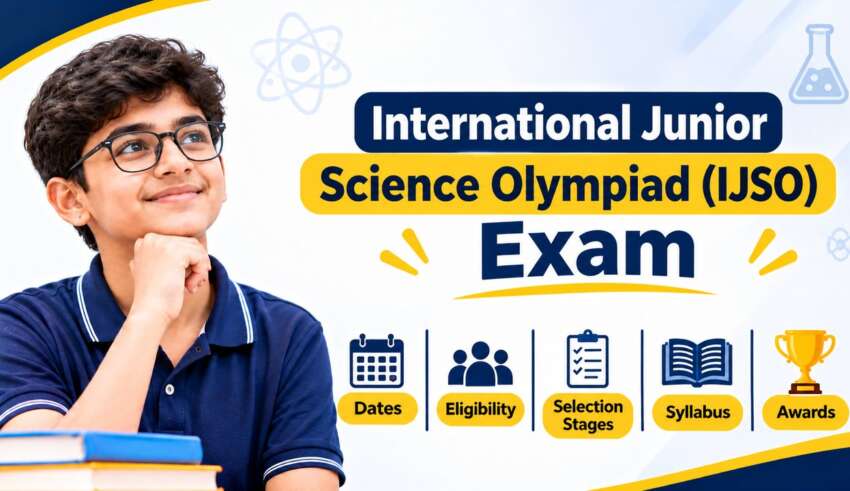
The International Junior Science Olympiad (IJSO) 2026-27 gives Indian students an opportunity to put India on the global map in a Science Olympiad. Students in Classes 8, 9, and 10 are eligible and the first (offline) exam will be held at a registered school or centre. The first stage is NSEJS which is the ‘National Standard Examination in Junior Science’. Students participate in INJSO selection camp and training camp before the final IJSO 2027 after it. Students will be able to join through their school or online at iapt.org.in. The first stage of the exam was held on 22 November 2026 and it is thought that the international test will follow in December 2027. The paper is made up of Physics, Chemistry and Biology and is rewarded to the curious and hard working young scientists.
This blog provides information about the IJSO exam date, IJSO eligibility criteria 2027, selection process, IJSO syllabus and awards. Facts are taken from iapt.org.in and ijsoweb.org.
Read More:
Highlights of the International Junior Science Olympiad (IJSO)
International Junior Science Olympiad (IJSO) is an annual competition. It is not restricted to students of a particular age, unless they are over 15 years of age by 31st December of the competition year. The Indian Association of Physics Teachers (IAPT) conducts all the phases of the Junior Science Olympiad in India. Students gain entry into NSEJS and this is the actual gate for IJSO. This table provides information for 2026-27.
| Detail | Information |
| Exam name | International Junior Science Olympiad (IJSO) |
| Conducting body in India | Indian Association of Physics Teachers (IAPT) |
| First stage | National Standard Examination in Junior Science (NSEJS) 2026 |
| Eligible classes | Class 8, 9 and 10 |
| Eligible date of birth for students | 1 January 2012 to 31 December 2013 |
| Subjects | Physics, Chemistry and Biology |
| Mode | Offline, with an OMR sheet |
| Venue | Registered NSE centre, usually a school |
| Registration dates | 21 August to 14 September 2026 |
| Fee | Rs 300 |
| NSEJS exam date | 22 November 2026, 2:30 PM to 4:30 PM |
| Result date | 25 December 2026 (expected) |
| Levels | NSEJS, INJSO, OCSC, training camp, IJSO |
| Official websites | iapt.org.in and ijsoweb.org |
What Are the Important IJSO Exam Dates for 2026-27?
The students frequently look for the International Junior Science Olympiad (IJSO) 2026-27 Details. The dates given below are from IAPT NSE 2026 brochure and IJSO website. The later dates are probable as per IAPT so the students should check on iapt.org.in for updates.
| Event | Date |
| Student enrolment | 21 August to 14 September 2026 |
| NSEJS 2026 exam | Sunday, 22 November 2026, 2:30 PM to 4:30 PM |
| NSEJS result | 25 December 2026 (expected) |
| INJSO exam | First week of February 2027 (probable) |
| INJSO result | Last week of February 2027 (expected) |
| Orientation-Cum-Selection Camp (OCSC) | April to June 2027 |
| IJSO 2027 (international) | December 2027 (expected, host not announced) |
After result, the students who took NSEJS on 22 November 2026 can avail the report card from iapt.org.in. The INJSO shortlist is determined by the score.
Important note: Please not confuse the years. Official website (idioms website) states that the IJSO 2026 is happening in Sofia, Bulgaria in December, 2026. It is this team that was selected last year. Students from this cycle have their targets set for IJSO 2027.
Which Levels Must Students Clear Before the IJSO?
To reach the International stage, students need to clear 4 levels. IAPT considers the IJSO selection process to follow five stages and the following shows them.
- Stage 1, NSEJS: Students write a two-hour paper at a registered centre in November. A small number of students (around 300) are selected as ‘short-listed’ by IAPT for the next level in the assessment.
- Stage 2, INJSO: The Indian National Junior Science Olympiad (INJSO) Stage 2 will be held in early 2027. IAPT selects students on the basis of state quota and a 20 per cent share for girls on the basis of the students’ scores.
- Stage 3, OCSC: The Orientation-Cum-Selection Camp will be held in Mumbai or Bengaluru for approximately 2 weeks in Stage 3. Theory and lab tests are conducted there for students.
- Stage 4 – training camp: the chosen students undergo last practice before travel.
Team then moves to IJSO after these levels. A normal team consists of 6 students and 3 leaders. HBCSE states that the NSEJS and INJSO are conducted in full by IAPT itself and students are advised to approach IAPT with their queries.
What Is the IJSO Eligibility Criteria for 2027?
The student should be a student of either Class 8, 9 or 10. Must be born between 1 January 2012 and 31 December 2013. Listed in the IJSO eligibility criteria 2027, they also ask for an Indian passport. IAPT has laid down these conditions for NSEJS 2026 and all the subsequent stages follow that too.
- The student must be eligible to hold an Indian passport.
- The candidate should be born between 1 January 2012 and 31 December 2013, (inclusive).
- Must have been residing and studying in India from 30 November 2024 or before. Since that time, is a student’s study in Indian school then that also works.
- The student must not finish the Class 10 board exam before 30 November 2026.
- The student must not appear in NSEA, NSEB, NSEC or NSEP 2026.
As per IJSO, a student must hold a valid passport of the country, or study there for at least one academic year. A student must not be in university education.
Students who have already participated in IJSO from India do not have to write NSEJS. As described in the IAPT brochure, they need to submit a written request for it, as direct entry.
How Can Students Complete the IJSO Registration Process?
Students do not register for IJSO, but for NSEJS. The registration procedure of IJSO is conducted through a school centre or IAPT website.
- Step 1: Check with school about their registration as an NSE centre. If so, the Principal or a science teacher enrols you.
- Step 2: If it is not, visit (idioms dictionary) iapt.org.in and open the student enrolment link. It opened on 21 August 2026.
- Step 3: Fill in your name as per school records, class, birth date, school details and address. Choose the language of the paper too.
- Step 4: Pay the Rs 300 fee. It cannot be refunded by IAPT.
- Step 5: You can use the “Check your Enrolment” within seven working days to verify your status.
- Step 6: Carry the hall ticket and an identity proof on exam day.
According to IAPT exam portal 16 September 2026 was the last date for registration. Registration for this cycle is now closed. The 2026 cycle began on 21 August, so students should watch iapt.org.in from August 2027. IAPT charges no extra fee for later stages. Students pay once, at NSEJS enrolment.
What Is the IJSO Paper Pattern?
The NSEJS paper is in a Multiple Choice type with 60 questions and 216 marks, with 2 hours allowed. The international IJSO paper pattern is different and the tables below present it. Time is very important in NSEJS as a test since you are allotted roughly 2 minutes per question.
| NSEJS 2026 Feature | Details |
| Duration | 2 hours, from 2:30 PM to 4:30 PM |
| Level | CBSE Class 10 science |
| Part A | 48 questions, one correct option, 3 marks for a right answer, minus 1 for a wrong answer (144 marks) |
| Part B | 12 questions of 6 marks each, one or more correct options, no negative marking (72 marks) |
| Total marks | 216 |
| Part B rule | Marks come only when students mark all correct options and no wrong option |
| International Paper | Format | Marks |
| MCQ | 30 questions, 10 each from Physics, Chemistry and Biology, with 1 mark for a right answer and minus 0.25 for a wrong one | 30 |
| Theory | Written problems that mix the three subjects, solved alone | 30 |
| Practical | Lab experiments, solved in a team of three students | 40 |
The International papers are three to four hours each and held on three different days. Total mark for the assignment is 100.
What Is the IJSO Syllabus?
The NSEJS runs alongside CBSE 10th Science level, and Physics and Chemistry and Biology are equally weighted. The International Junior Science Olympiad syllabus is broader. In December 2020, IJSO board modified it, and it was effective from January 2022. The IJSO syllabus is divided on the basis of groups, not on the basis of three subjects.
| Theme | Main Topics |
| General science skills | Scientific method, graphs, SI units, significant figures, error sources |
| Particles, waves and matter | States of matter, atomic structure, periodic table, gas laws |
| Energy | Exothermic and endothermic reactions, electrochemical cells, work, power, energy sources |
| Interactions | Mole concept, chemical reactions, bonding, equilibrium, acids and pH, forces, motion, light, sound, electricity, heat |
| Structure, properties and functions | Biomolecules, classification, cell biology, cell division, microbes, immunity, solar system |
| Systems | Plant tissues, photosynthesis, animal tissues, human body systems |
| Development and evolution | Genetics, Mendel’s laws, evolution, ecology, food webs, pollution |
| Mathematics skills | Equations, basic geometry, vectors, mean values |
| Laboratory skills | Microscope, titration, pH measurement, separation methods, safe lab work |
A few topics, such as equilibrium and Hess’s law as well as buffer solutions extend beyond class 10. They require additional reading by students.
Where Can Students Find IJSO Sample Papers and Previous Year Papers?
IJSO previous year papers of best quality are available on Downloads page of ijsoweb.org. Official web-sites present mostly past papers and students use these papers as International Junior Science Olympiad sample papers. Follow this procedure when you want to download them.
- Open ijsoweb.org and click Downloads.
- Select a year as the page includes papers from 2007-2023.
- Pick the MCQ, Theory or Experiment paper.
- Click Questions, then open the Answer Key or Solutions link and save the PDF.
- The MCQ paper consists of 10 Physics questions, 10 Chemistry questions, and 10 Biology questions.
IAPT sells NSEJS Practice Booklets comprising of the last 10 years paper and answers for Junior Science. A booklet sells for Rs 150. A booklet is sent to students by registered post. There are 3 reasons for using past papers. Students get familiar with the question style, understand negative marking, and identify weak chapters.
What Are the IJSO Awards and Scholarships?
In IJSO awards students are awarded with gold, silver, and bronze medals at international level. In India, IAPT awards certificates, book prizes and gold medals throughout the process.
| Level | Award |
| NSEJS, every student | Report card to download |
| NSEJS, top 10% at each centre | Certificate |
| NSEJS, top 1% in each state | Merit certificate |
| NSEJS, national top 1% | Special merit certificate and book prize |
| Shortlisted for INJSO | Certificate |
| OCSC, every student | Merit certificate and gold medal |
| IJSO, top 10% of students | Gold medal |
| IJSO, next 20% | Silver medal |
| IJSO, next 30% | Bronze medal |
| IJSO, other students | Participation certificate |
| IJSO, special prizes | Overall winner, best theory winner and country winner |
Every student who reaches the camp already takes home a gold medal. The IJSO statutes say medals never go above 60 per cent of students. The host country also pays for stay and food during the event.
How Should Students Prepare for IJSO 2027?
Use NCERT science books of class 8, 9 and 10 as your first choice. IAPT has suggested that the first stage does not require any special coaching while it is important to have good classroom learning.
- Read each NCERT chapter slowly and mark topics that match the IJSO syllabus.
- Topics come from Class 10, but not in the official syllabus PDF, like gas laws, equilibrium and pH etc.
- Practice past papers, under timed conditions and verify all answers against the key.
- Perform Part B carefully; it will only award marks if every selected option is correct.
- Keep a mistake notebook and read it again each week.
Each fact was checked against the IAPT NSE 2026 brochure, the brochure of HBCSE and the official website of IJSO. Note: Before taking any action, please be sure to visit iapt.org.in again.
Frequently Asked Questions (FAQs): IJSO 2026-27
Q1. What is the full form of IJSO?
IJSO is International Junior Scientists Olympiad. It is an annual science competition for young students aged 15 and below as of 31 December the year of the competition.
Q2. Who conducts the IJSO in India?
IAPT organizes every phase of the Junior Science Olympiad in India which includes NSEJS.
Q3. Is there negative marking in NSEJS?
Yes, 1 mark is deducted for each incorrect response to part A. There is no negative marking in part B.
Q4. How many students form an IJSO team?
As given in IJSO statues, the normal team consists of 6 students and 3 leaders.
Q5. Does the IJSO help in JEE or NEET?
It doesn’t have any direct admission in JEE or NEET. It definitely provides good foundations in Physics, Chemistry and Biology.
Q6. Which websites give official IJSO updates?
Students are advised to follow the news of NSEJS and INJSO on their websites: iapt.org.in & jso.indapt.org.in respectively. The international event is covered on the Website www.ijsoweb.org.
Written By: Saumya Sarin (Content Writer at Motion Education)
Reviewed By: Motion Education Foundation Team
Last Updated: November, 2026