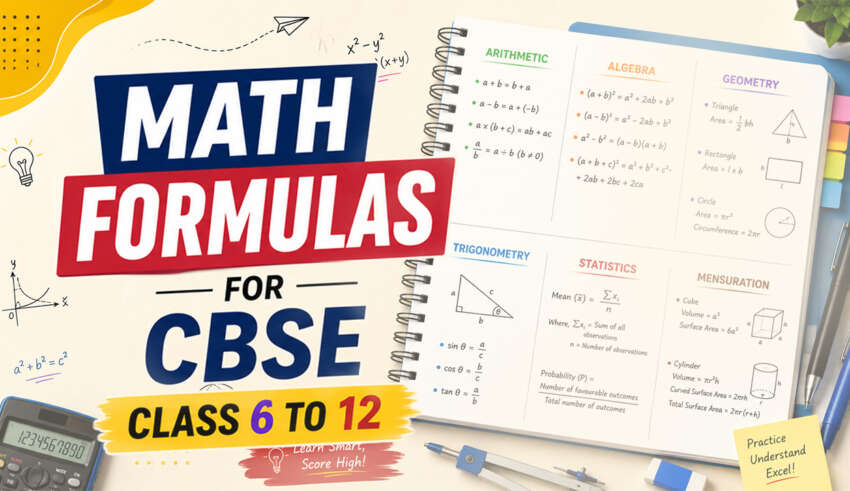
It is not enough to simply memorise a Math formula for CBSE Class 6 to 12 for an exam; the formulas are, in fact, the foundation of every solution you will write. If you are a Class 6 student learning algebra or a Class 12 student preparing for JEE or CBSE board exam 2027, the right formula, used correctly, can make the difference between the smooth flow of a step and a whole page of crossed-out attempts.
Most students look for these formulas in an urgent and hurried manner the night before a test, hopping from one web source to another and finding no assurance which of them covers their current syllabus. Therefore, this guide fixes this issue. It includes all the classes from 6 to 12 and covers the updated CBSE syllabus 2026-27 (with chaining of new NCERT textbooks Ganita Prakash and Ganita Manjari) and provides you with formula chapters, which help you know exactly where to look. Bookmark this.
Download:
- CBSE Class 11th Syllabus 2026-27 PDF Download Subject Wise
- CBSE Class 12th Syllabus 2026-27: Download Latest CBSE 12th Syllabus PDF
- CBSE Class 10th Syllabus 2026-27: Complete CBSE Syllabus
Why CBSE Math Formulas Matter More Than You Think (Especially for 2026–27 Exams)
Consider a formula as a shortcut that mathematicians have developed over hundreds of years to calculate some value, so you don’t have to rederive it yourself. That is where most students go wrong, though: They don’t know the origins of a formula, or when to use it. The understanding and thinking have been the focal point for CBSE to test over and over since 2023, and it will feature again in the 2026- 27 board cycle. The new question pattern to be adopted is not memorisation of the formula, but it is competency-based. Conceptual applications will be accepted.
Important Note: New NCERT Textbooks for 2026–27: What Has Changed?
In Class 6,7,8,9, look closely! Based on NCF-SE 2023 and NEP 2020, the NCERT has new textbooks launched for the session 2026-27. Now the Classes 6, 7 and 8 are using Ganita Prakash, and Class 9 is using Ganita Manjari Part 1. These are not simply “renamed” books, but a style of teaching that is concept-centric, rather than formulaic. Old chapters have been reorganised and renamed; some chapters have been rewritten. This information is updated as needed. The Grade 10th, 11th and 12th continue with the current NCERT textbooks, but with some changes.
Check Out: CBSE 10th Books 2026-27: Check Subject-Wise Reference Books
Chapter-Wise Math Formulas: CBSE Class 6 to 12 (2026–27 Syllabus)
Class 6 Maths Formulas – Ganita Prakash (2026–27)
It starts here at CLASS 6. The new book by Ganita Prakash is a hands-on approach. The key chapters are: Perimeter and Area, Fractions and The Other Side of Zero. Area and perimeter formulas for squares, rectangles and triangles are introduced here and will continue to hold to the end of Class 10.
CBSE Class 6 Maths Formulas
Number Systems & Whole Numbers
- Commutative Property (Addition): a + b = b + a
- Commutative Property (Multiplication): a × b = b × a
- Associative Property (Addition): (a + b) + c = a + (b + c)
- Associative Property (Multiplication): (a × b) × c = a × (b × c)
- Distributive Property: a × (b + c) = (a × b) + (a × c)
- Additive Identity: a + 0 = a
- Multiplicative Identity: a × 1 = a
Playing with Numbers
- HCF & LCM Product Rule: HCF(a, b) × LCM(a, b) = a × b
Mensuration (2D Perimeter & Area)
- Perimeter of a Rectangle: 2 × (Length + Breadth)
- Area of a Rectangle: Length × Breadth
- Perimeter of a Square: 4 × Side
- Area of a Square: Side × Side
- Perimeter of an Equilateral Triangle: 3 × Side
Data Handling
- Mean (Average): Sum of all observations ÷ Total number of observations
Insight: If you get used to fractions now, rational numbers in the 7th class will be easy.
Class 7 Maths Formulas – Ganita Prakash (2026–27)
The most prominent chapters in Class 7 are: Triangles and Their Properties, Simple Equations, and Comparing Quantities. In Class 7, you learned the triangle angle rules, and it is useful to grasp the idea of ratio as you learn more about geometry in Classes 9 and 10. Many students who find it hard in algebra in class 8 or 9 can trace it to the unreliability in solving Simple Equations in this class. But take (take with a grain of salt idiom synonym) that chapter seriously!
CBSE Class 7 Maths Formulas
Integers & Fractions
- Multiplication of Fractions = (Product of Numerators) ÷ (Product of Denominators)
- Reciprocal of a Fraction = If the fraction is a/b, then its reciprocal is b/a
Comparing Quantities
- Simple Interest (SI) = (P × R × T) ÷ 100
- Total Amount (A) = P + SI
- Profit = Selling Price (SP) − Cost Price (CP)
- Loss = Cost Price (CP) − Selling Price (SP)
- Profit Percentage = (Profit ÷ CP) × 100
- Loss Percentage = (Loss ÷ CP) × 100
Perimeter and Area
- Area of a Parallelogram = Base × Height
- Area of a Triangle = (1/2) × Base × Height
- Circumference of a Circle = 2 × π × r
- Area of a Circle = π × r²
Exponents and Powers
- Product Exponent Rule = aᵐ × aⁿ = aᵐ⁺ⁿ
- Quotient Exponent Rule = aᵐ ÷ aⁿ = aᵐ⁻ⁿ
- Power of a Power Rule = (aᵐ)ⁿ = aᵐⁿ
- Power of a Product Rule = aᵐ × bᵐ = (ab)ᵐ
- Zero Exponent Law = a⁰ = 1
Class 8 Maths Formulas – Ganita Prakash (2026–27)
Class 8 is a ‘bridge’ class, and it is a very significant year. All those algebraic identities you learn here (a+b)2, (a-b)2, (a+b) (a-b) are recurring in Class 9, 10 and even in Class 11 calculus. The two chapters that require utmost attention are Algebraic Expressions and Identities, and Mensuration. The formulas for surface area and volume are introduced to cubes, cuboids and cylinders at Class 8 Mensuration.
CBSE Class 8 Formulas
Rational Numbers
- Additive Inverse: Additive inverse of a/b is -a/b
- Multiplicative Inverse (Reciprocal): Multiplicative inverse of a/b is b/a
Comparing Quantities & Commercial Math
- Compound Interest Amount (Annual): A = P(1 + R/100)^n
- Compound Interest Amount (Half-Yearly): A = P(1 + R/200)^(2n)
- Compound Interest (CI): CI = A – P
- Discount = Marked Price (MP) – Selling Price (SP)
- Discount Percentage = (Discount ÷ MP) × 100
Algebraic Expressions & Identities
- Identity I: (a + b)² = a² + 2ab + b²
- Identity II: (a – b)² = a² – 2ab + b²
- Identity III: a² – b² = (a – b)(a + b)
- Identity IV: (x + a)(x + b) = x² + (a + b)x + ab
Mensuration (3D Surface Area & Volume)
- Total Surface Area of a Cube = 6a²
- Lateral Surface Area of a Cube = 4a²
- Volume of a Cube = a³
- Total Surface Area of a Cuboid = 2(lb + bh + hl)
- Lateral Surface Area of a Cuboid = 2h(l + b)
- Volume of a Cuboid = l × b × h
- Curved Surface Area of a Cylinder = 2πrh
- Total Surface Area of a Cylinder = 2πr(r + h)
- Volume of a Cylinder = πr²h
Class 9 Maths Formulas – Ganita Manjari Part 1 (2026–27)
This year, there has been a really big syllabus change in class 9 with the new Ganita Manjari Part 1. A new structure of 8 chapters on Coordinates, Algebraic Identities, Geometry, Mensuration, Statistics and Probability (check with your teacher if your school still uses the previous edition). Chapters covering polynomials and coordinate geometry are particularly important as they will directly feed into the Class 10th Board problem. Another formula that appears regularly in board exams from CBSE Class 9 Maths formula is the area of a triangle using Heron’s formula.
CBSE Class 9 Formulas
Number Systems
- Laws of Radicals:
√ab = √a × √b - Rationalizing Denominator Property:
1 / (√a + b) × (√a − b) / (√a − b)
Polynomials
- Trinomial Expansion:
(a + b + c)² = a² + b² + c² + 2ab + 2bc + 2ca - Cubic Identity (Sum):
(a + b)³ = a³ + b³ + 3ab(a + b) - Cubic Identity (Difference):
(a − b)³ = a³ − b³ − 3ab(a − b) - Sum of Cubes:
a³ + b³ = (a + b)(a² − ab + b²) - Difference of Cubes:
a³ − b³ = (a − b)(a² + ab + b²) - Special Cubic Property:
If a + b + c = 0, then
a³ + b³ + c³ = 3abc
Coordinate Geometry & Linear Equations
- Linear Equation Standard Form:
ax + by + c = 0
Heron’s Formula
- Semi-perimeter (s):
s = (a + b + c) / 2 - Area of Triangle:
Area = √[s(s − a)(s − b)(s − c)]
Surface Areas and Volumes
- Curved Surface Area of a Cone:πrl
- where slant height, l = √(r² + h²)
- Total Surface Area of a Cone:πr(l + r)
- Volume of a Cone:(1/3)πr²h
- Surface Area of a Sphere:4πr²
- Volume of a Sphere:(4/3)πr³
- Curved Surface Area of a Hemisphere:2πr²
- Total Surface Area of a Hemisphere:3πr²
- Volume of a Hemisphere:(2/3)πr³
Tip: Do not consider Class 9 as a non-boarding class, as the things to know in this class determine your pace in Class 10.
Class 10 Maths Formulas – CBSE Board Level (2026–27)
Marks begin to count from Class 10 onwards. CBSE Maths formulas class 10 cover all chapters, including Real Numbers, and Polynomials to Trigonometry, Co-ordinate Geometry, and Surface area and volumes. The following chapters are the most frequently recurring ones that consistently attract marks: Trigonometric Identities, Quadratic Equations, Arithmetic Progressions and Coordinate Geometry.
CBSE Class 10 Maths Formulas
Real Numbers
- Fundamental Relation: HCF(a, b) × LCM(a, b) = a × b
Polynomials & Quadratic Equations
- Quadratic Roots Relationship: α + β = -b/a and αβ = c/a
- Quadratic Formula: x = (-b ± √D) / 2a
- Discriminant: D = b² – 4ac
Arithmetic Progressions (AP)
- n-th Term: an = a + (n – 1)d
- Sum of n Terms: Sn = n/2 [2a + (n – 1)d] = n/2 (a + l)
Coordinate Geometry
- Distance Formula: d = √[(x₂ – x₁)² + (y₂ – y₁)²]
- Section Formula (Internal): x = (mx₂ + nx₁)/(m + n), y = (my₂ + ny₁)/(m + n)
- Midpoint Formula: ((x₁ + x₂)/2, (y₁ + y₂)/2)
Trigonometry
- sinθ = Perpendicular / Hypotenuse
- cosθ = Base / Hypotenuse
- tanθ = Perpendicular / Base
- sin²θ + cos²θ = 1
- 1 + tan²θ = sec²θ
- 1 + cot²θ = cosec²θ
Circles & Statistics
- Length of an Arc: (θ/360°) × 2πr
- Area of a Sector: (θ/360°) × πr²
- Empirical Formula: Mode = 3(Median) – 2(Mean)
Insight: You can earn 20 marks by using the quadratic formula, the distance and section formula and the standard trig ratios, if you use them correctly.
For Practice Download: CBSE Previous Year Question Papers for Class 10 All Subjects with Solutions
Class 11 Maths Formulas – CBSE (2026–27)
In the CBSE Class 11 maths syllabus 2026-27, students are introduced to Sets, Functions, Trigonometric Functions, Complex Numbers, Sequences and Series, Conic Sections and Limits and Derivatives in just (just in case definition) one year. Calculus starts with limits and derivatives and one of the most essential changes in this class is when a derivative is constructed from first principles. If you are one of those who are studying for JEE, then give extra time (race against time phrase meaning) to Binomial Theorem, Sequences and Series, and Conic Sections.
Class 11 Maths Formula
Unit I: Sets and Functions
Chapter 1: Sets
- Union of Two Sets: n(A ∪ B) = n(A) + n(B) – n(A ∩ B)
- Disjoint Sets: n(A ∩ B) = 0 ⇒ n(A ∪ B) = n(A) + n(B)
- Three-Set Union Identity: n(A ∪ B ∪ C) = n(A) + n(B) + n(C) – n(A ∩ B) – n(B ∩ C) – n(C ∩ A) + n(A ∩ B ∩ C)
- De Morgan’s Laws: (A ∪ B)’ = A’ ∩ B’ and (A ∩ B)’ = A’ ∪ B’
- Difference of Sets: n(A – B) = n(A) – n(A ∩ B)
Chapter 2: Relations and Functions
- Cartesian Product Element Count: n(A × B) = n(A) × n(B)
- Total Possible Relations: Total Relations from A to B = 2^[n(A) × n(B)]
Chapter 3: Trigonometric Functions
- Radian Measure Conversion: Radian Measure = (π/180) × Degree Measure
- Arc Length Formula: l = rθ
- sin(x ± y) = sinx cosy ± cosx siny
- cos(x ± y) = cosx cosy ∓ sinx siny
- tan(x ± y) = (tanx ± tany) / (1 ∓ tanx tany)
- sin2x = 2sinx cosx = 2tanx / (1 + tan²x)
- cos2x = cos²x – sin²x = 2cos²x – 1 = 1 – 2sin²x = (1 – tan²x) / (1 + tan²x)
- tan2x = 2tanx / (1 – tan²x)
- sin3x = 3sinx – 4sin³x
- cos3x = 4cos³x – 3cosx
- sinx + siny = 2sin[(x+y)/2] cos[(x-y)/2]
- cosx – cosy = -2sin[(x+y)/2] sin[(x-y)/2]
Unit II: Algebra
Chapter 4: Complex Numbers and Quadratic Equations
- Standard Form: z = a + ib
- Modulus: |z| = √(a² + b²)
- Conjugate: z̅ = a – ib
- Multiplicative Inverse: z⁻¹ = z̅ / |z|²
- Complex Quadratic Roots: x = (-b ± i√(4ac – b²)) / 2a
Chapter 5: Linear Inequalities
- Inequality Rule: a < b ⇒ -a > -b
Chapter 6: Permutations and Combinations
- Factorial Formula: n! = n × (n-1) × (n-2) × … × 1
- Permutation Formula: ⁿPr = n! / (n-r)!
- Combination Formula: ⁿCr = n! / [r!(n-r)!]
- Property: ⁿCr = ⁿC(n-r)
- Property: ⁿCr + ⁿC(r-1) = ⁿ⁺¹Cr
Chapter 7: Binomial Theorem
- Binomial Expansion: (a + b)ⁿ = ⁿC₀aⁿ + ⁿC₁aⁿ⁻¹b + ⁿC₂aⁿ⁻²b² + … + ⁿCnbⁿ
- General Term: T(r+1) = ⁿCraⁿ⁻ʳbʳ
- Total Terms in (a+b)ⁿ = n + 1
Chapter 8: Sequences and Series
- AP nth Term: an = a + (n-1)d
- Sum of AP: Sn = n/2 [2a + (n-1)d] = n/2 (a + an)
- Arithmetic Mean: AM = (a+b)/2
- GP nth Term: an = arⁿ⁻¹
- Sum of GP: Sn = a(rⁿ – 1) / (r – 1)
- Geometric Mean: GM = √ab
Unit III: Coordinate Geometry
Chapter 9: Straight Lines
- Distance Formula: d = √[(x₂-x₁)² + (y₂-y₁)²]
- Section Formula: (x,y) = ((mx₂ + nx₁)/(m+n), (my₂ + ny₁)/(m+n))
- Slope Formula: m = tanθ = (y₂-y₁)/(x₂-x₁)
- Parallel Lines: m₁ = m₂
- Perpendicular Lines: m₁ × m₂ = -1
- Point-Slope Form: y – y₁ = m(x – x₁)
- Slope-Intercept Form: y = mx + c
- Intercept Form: x/a + y/b = 1
- Perpendicular Distance Formula: d = |Ax₁ + By₁ + C| / √(A² + B²)
Chapter 10: Conic Sections
- Circle Equation: (x-h)² + (y-k)² = r²
- Parabola Equation: y² = 4ax
- Ellipse Equation: x²/a² + y²/b² = 1
- Ellipse Eccentricity: e = √(1 – b²/a²)
- Ellipse Foci: (±ae, 0)
- Hyperbola Equation: x²/a² – y²/b² = 1
- Hyperbola Eccentricity: e = √(1 + b²/a²)
Chapter 11: Introduction to Three-Dimensional Geometry
- 3D Distance Formula: d = √[(x₂-x₁)² + (y₂-y₁)² + (z₂-z₁)²]
- 3D Midpoint Formula: ((x₁+x₂)/2, (y₁+y₂)/2, (z₁+z₂)/2)
Unit IV: Calculus
Chapter 12: Limits and Derivatives
- Standard Limit: lim(x→a) [(xⁿ – aⁿ)/(x-a)] = naⁿ⁻¹
- lim(x→0) (sinx/x) = 1
- lim(x→0) [(1-cosx)/x] = 0
- lim(x→0) [(eˣ -1)/x] = 1
- lim(x→0) [ln(1+x)/x] = 1
- Derivative First Principle: f'(x) = lim(h→0) [f(x+h)-f(x)]/h
- Product Rule: d(uv)/dx = u(dv/dx) + v(du/dx)
- Quotient Rule: d(u/v)/dx = [v(du/dx) – u(dv/dx)] / v²
- Chain Rule: d[f(g(x))]/dx = f'(g(x)) × g'(x)
Unit V: Statistics and Probability
Chapter 13: Statistics
- Mean Formula: x̄ = Σxᵢ / n
- Mean Deviation: MD(x̄) = Σ|xᵢ – x̄| / n
- Variance Formula: σ² = [Σ(xᵢ – x̄)²]/n = (Σxᵢ² / n) – (x̄)²
- Standard Deviation: σ = √Variance
Chapter 14: Probability
- Probability Formula: P(A) = Favorable Outcomes / Total Outcomes
- Addition Theorem: P(A ∪ B) = P(A) + P(B) – P(A ∩ B)
- Mutually Exclusive Events: P(A ∩ B) = 0 ⇒ P(A ∪ B) = P(A) + P(B)
- Complementary Event Probability: P(A’) = 1 – P(A)
Tip: There is a theory paper of 80 marks divided into five units and the internal 20 marks. Most students underestimate the difficulty of class 11 and hence underperform in class 12. Begin to build a formula notebook from Chapter 1.
Class 12 Maths Formulas – CBSE Board (2026–27)
Class 12 is the final stretch. CBSE Class 12 Maths syllabus 2026-27 has a 13-chapter syllabus that is grouped into six units: Relations and Functions, Matrices and Determinants, Calculus (which alone carries 35 out of 80 theory marks), Vectors and 3D Geometry, Linear Programming, and Probability. Integration formulas, differentiation rules (especially the chain rule), Bayes’ theorem, and vector identities are the most frequently tested.
Class 12 Maths Formula
Unit I: Relations and Functions
Chapter 1: Relations and Functions
- Reflexive Relation: (a, a) ∈ R for all a ∈ A
- Symmetric Relation: (a, b) ∈ R ⇒ (b, a) ∈ R
- Transitive Relation: (a, b) ∈ R and (b, c) ∈ R ⇒ (a, c) ∈ R
- Equivalence Relation: A relation that is reflexive, symmetric, and transitive
- One-to-One (Injective) Function: f(x₁) = f(x₂) ⇒ x₁ = x₂
- Onto (Surjective) Function: For every y ∈ Y, there exists x ∈ X such that f(x) = y
- Bijective Function: A function that is both injective and surjective
Chapter 2: Inverse Trigonometric Functions
- sin⁻¹x ⇒ [-π/2, π/2]
- cos⁻¹x ⇒ [0, π]
- tan⁻¹x ⇒ (-π/2, π/2)
- sin⁻¹(1/x) = cos⁻¹x
- sin⁻¹x + cos⁻¹x = π/2
- tan⁻¹x + cot⁻¹x = π/2
- sec⁻¹x + csc⁻¹x = π/2
Unit II: Algebra
Chapter 3: Matrices
- Order of Matrix: m × n
- Transpose of Matrix: (Aᵀ)ij = Aji
- (AB)ᵀ = BᵀAᵀ
- (Aᵀ)ᵀ = A
- Symmetric Matrix: Aᵀ = A
- Skew-Symmetric Matrix: Aᵀ = -A
- Matrix Decomposition: A = 1/2(A + Aᵀ) + 1/2(A – Aᵀ)
Chapter 4: Determinants
- Determinant of Order 2: |a b; c d| = ad – bc
- Area of Triangle: Δ = 1/2 |x₁ y₁ 1; x₂ y₂ 1; x₃ y₃ 1|
- Adjoint Identity: A(adj A) = (adj A)A = |A|I
- Inverse of Matrix: A⁻¹ = (1/|A|) × adj A
- Matrix Equation Solution: X = A⁻¹B
Unit III: Calculus
Chapter 5: Continuity and Differentiability
- Continuity Condition: lim(x→c⁻) f(x) = lim(x→c⁺) f(x) = f(c)
- Chain Rule: dy/dx = (dy/du) × (du/dx)
- Parametric Differentiation: dy/dx = (dy/dt) / (dx/dt)
- Logarithmic Differentiation: ln y = g(x) ln[f(x)]
Chapter 6: Applications of Derivatives
- Rate of Change: dy/dx = (dy/dt) / (dx/dt)
- Increasing Function: f'(x) > 0
- Decreasing Function: f'(x) < 0
- First Derivative Test: f'(c) = 0
- Local Minimum: f”(c) > 0
- Local Maximum: f”(c) < 0
Chapter 7: Integrals
- ∫xⁿ dx = xⁿ⁺¹/(n+1) + C
- ∫(1/x) dx = log|x| + C
- ∫eˣ dx = eˣ + C
- ∫dx/(x²-a²) = (1/2a) log|(x-a)/(x+a)| + C
- ∫dx/√(a²-x²) = sin⁻¹(x/a) + C
- ∫dx/(x²+a²) = (1/a) tan⁻¹(x/a) + C
- Integration by Parts: ∫u·v dx = u∫v dx – ∫[u’∫v dx] dx
- Definite Integral Property: ∫ₐᵇ f(x) dx = ∫ₐᵇ f(a+b-x) dx
Chapter 8: Applications of Integrals
- Area under Curve: Area = ∫ₐᵇ y dx = ∫ₐᵇ f(x) dx
Chapter 9: Differential Equations
- Order = Highest derivative present
- Degree = Power of highest derivative
- Variable Separable Form: f(x)dx = g(y)dy
- Linear Differential Equation: dy/dx + Py = Q
- Integrating Factor: IF = e^(∫P dx)
- General Solution: y(IF) = ∫(Q × IF) dx + C
Unit IV: Vectors and Three-Dimensional Geometry
Chapter 10: Vector Algebra
- Magnitude of Vector: |a⃗| = √(x² + y² + z²)
- Dot Product: a⃗·b⃗ = |a⃗||b⃗| cosθ
- cosθ = (a⃗·b⃗) / (|a⃗||b⃗|)
- Perpendicular Condition: a⃗·b⃗ = 0
- Cross Product: a⃗×b⃗ = |a⃗||b⃗| sinθ n̂
- Parallel Condition: a⃗×b⃗ = 0
- Projection Formula: Projection = (a⃗·b⃗) / |b⃗|
Chapter 11: Three-Dimensional Geometry
- Direction Cosines: l² + m² + n² = 1
- Vector Equation of Line: r⃗ = a⃗ + λb⃗
- Cartesian Equation of Line: (x-x₁)/a = (y-y₁)/b = (z-z₁)/c
- Shortest Distance Between Skew Lines: d = |[(b⃗₁×b⃗₂)·(a⃗₂-a⃗₁)] / |b⃗₁×b⃗₂||
Unit V: Linear Programming
Chapter 12: Linear Programming Problems
- Objective Function: Z = ax + by
- Corner Point Theorem: Optimal value occurs at corner points of feasible region
Unit VI: Probability
Chapter 13: Probability
- Conditional Probability: P(A|B) = P(A ∩ B) / P(B)
- Multiplication Theorem: P(A ∩ B) = P(A) × P(B|A)
- Independent Events: P(A ∩ B) = P(A) × P(B)
- Total Probability Theorem: P(A) = Σ P(Eᵢ) × P(A|Eᵢ)
- Bayes’ Theorem: P(Eₖ|A) = [P(Eₖ) × P(A|Eₖ)] / Σ[P(Eᵢ) × P(A|Eᵢ)]
Insight: One good habit that really does help is to have a formula sheet with one page of formula per chapter, together with the condition when the formula is used, and one worked example for each. Do not rewrite it all in one go; go through it a few days at a time the night before. When combined with previous year papers (2020-25), this can potentially boost your result significantly.
For Practice Download: CBSE Previous Year Question Papers Class 12 With Solutions Download PDF
How to Actually Remember CBSE Maths Formulas – Tips That Work in 2026
Let’s get back to something teachers don’t say enough: you don’t memorise formulas by looking at them. They remind you of them by practising them until they feel automatic. These four methods do work.
- Write it, solve it, explain it: When writing a formula write 2 problems with it right away and look for their solutions. Explain it to a younger student and in your own words. This 3-step cycle will help you to remember the formula much better than re-reading.
- Group formulas by concept: Rather than memorising randomly, group related formulas, for example, all area formulas together, all trigonometric identities together, all differentiation rules together. Your brain builds connections between related ideas, which makes recall faster.
- Revisit within 24 hours: The forgetting rate maximises in the first 24 hours following learning. The retention rises by more than 60% if you rewrite a formula the following morning. Provide a 10-minute revision block each morning for formulas you learned the day before.
- Consider using previous year’s question papers: The CBSE question papers from the year 2020 to 2025 are available and exactly give you an idea of which formulas get tested most often. Perusing these papers is quite instructive: some formulas are repeated each year. Prioritise those.
Which CBSE Maths Formulas Are Asked Most Often in Board Exams?
There are some formula topics that come back each year from 2020 to 2025. Following the above analysis, the high-priority formula areas for the CBSE Board exam 2027 are listed below:
- Class 10: Trigonometric ratios and identities, the quadratic formula, AP sum and nth term formula, Heron’s formula, and the distance and section formula in coordinate geometry are the most consistently tested formula sets.
- Class 12: Integration by parts, standard integration formulas, differentiation of composite functions (chain rule), Bayes’ theorem in probability, the equation of a plane in vector form, and inverse trigonometric function properties are asked almost every year. Calculus alone accounts for 35 marks out of 80 in the theory paper.
Insight: Students who lose marks in board exams usually do not lose them because they did not know the formula. They lose marks because they applied the wrong formula in the right situation or forgot to check the condition under which a formula is valid. Always note conditions alongside formulas, not just the formulas themselves.
Final Thoughts: Build Your Formula Bank Early
Students who perform best on Maths board exams and competitive exams have not studied for the highest hours; They have reinforced their formula base throughout their study, and they have a strong base of formulas. This guide provides you with the class-wise structure. Now it’s your turn to put the formulas in, solve problems using them and check them on a regular basis throughout the 2026–27 session.
If you are revising for your class 10th exam or preparing for JEE entrance as in class 11th and 12th, then there are no better formulas than the CBSE maths formulas. Make this guide your personal living formula book this year, add to it, review it and carry it along with you throughout the year.
Frequently Asked Questions (FAQs)
Q1. Are these maths formulas based on the latest CBSE syllabus 2026–27?
Yes. This guide is updated as per the CBSE 2026–27 syllabus, including the new NCERT textbooks Ganita Prakash (Classes 6, 7, 8) and Ganita Manjari (Class 9). Classes 10, 11, and 12 are based on the current NCERT textbooks in use for the 2027 board exams.
Q2. Before the Board Exam, how should a Class 12 student revise all the Maths formulas?
The most effective method is to maintain a dedicated formula notebook, one page per chapter, with the formula, its condition, and one example. Revise this notebook every few days, not all at once. Pair this with solving CBSE previous year papers from 2020 to 2025 to see which formulas are tested most frequently.
Q3. Is the Ganita Prakash syllabus followed by all CBSE schools in 2026–27?
In accordance with NEP 2020 and NCF-SE 2023, most of the CBSE-affiliated schools have used Ganita Prakash books for students of Classes 6, 7 and 8 and Ganita Manjari for students of Class 9. But, some schools may still be in the use of the previous NCERT textbooks. Please check with your school maths teacher for this session on which textbook you are using.
Q4. Can memorising formulas alone help me score well in CBSE maths?
Not anymore. Since the year of 2022, the CBSE exam pattern has definitely undergone a change towards competency-based questions. That is, not only understanding what a formula is, but also when and how one should use it. Memorisation is what starts you out, understanding and application are what add to your score.
Q5. Where can I find CBSE maths formulas for all classes in one place?
This blog from Motion Education is right for that. Here is a chapter-wise formula structure for classes 6 to 12 as per the 2026-27 CBSE syllabus, which will help you practice them in exams. Keep it as a reference for the whole academic year and fill out the formulas as you read through each chapter.
Written By: Saumya Sarin (Content Writer at Motion Education)
Reviewed By: Senior Maths Faculty (Motion Education)
Last Updated: June, 2026