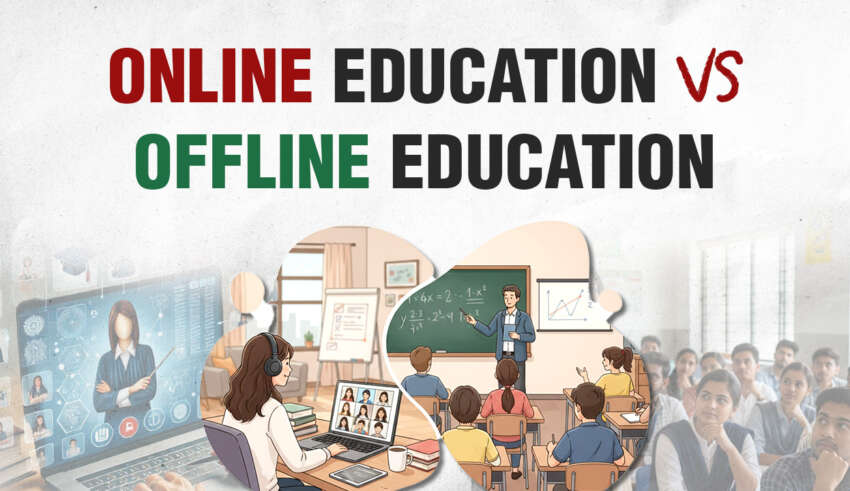
Quick Summary: This blog talks about online education and offline education and why students compare both today. Online study helps students learn from home with flexible time (race against time phrase meaning) and recorded classes. Offline study gives classroom learning, direct teacher support, and better focus. Both methods have their own value. The blog also includes a clear comparison, pros and cons, and tips to help students choose the right option for better learning.
Why Students Compare Online vs Offline Education: Introduction
Online Education vs Offline Education: Today, the way learning happens is changing very quickly. Because internet access has improved and digital platforms are growing, e-learning is now widely used instead of only depending on traditional classrooms. Even then, many students and parents still trust the disciplined routine of offline classes, which are also known as in-person or classroom learning.
If you are unsure about choosing Online vs Offline classes, you are not alone in this confusion. The topic of online vs. offline learning has become much more important, especially after learning styles changed across the world after 2020. Both methods of study, online and offline education, have their own good and weak points. With the help of online learning study becomes more flexible and easier to understand; on the other place offline education helps the students and learning through teachers directly, and helps them gain practical classroom experience. Many people feel that the overall learning level, co-curricular activities, and practical teaching provided through offline learning cannot be fully replaced, even with modern EdTech support.
This blog will help students clear their doubts related to virtual and in-person teaching. It will include functions of both systems, the advantages and disadvantages, and help students realize which option can be more suitable for their learning and fulfilling their future needs. Once the students clearly understand the difference between online vs offline education, it becomes quite easier for them to understand which path they should choose.
Check Out: Best Live Online Courses for JEE & NEET: Online Live Classes
Understanding Both Learning Methods
Online Education: Brief Introduction
Online classes allow students to study from any place and learn at their own pace. Where offline learning needs the students to be present physically, e-learning relies on digital platforms for conveying knowledge, interaction and assessments. These platforms offer video lessons, study notes, quizzes, and simple interactive tasks, making learning easy to access. This method suits students who prefer comfort, flexible schedules, and a wide choice of courses. Due to this, the comparison of digital learning vs classroom learning is becoming more important for students, parents, and teachers.
Offline Education: Brief Introduction
Known as the oldest method of teaching, offline education has been followed since early times and is still widely used today. It is anchored on face-to-face learning in which students and teachers assemble at the same physical location. This type of offline learning enables the students to not only develop in their studies but also in behaviour, habits as well as the entire personality.
In offline classes, students attend lessons in a fixed classroom from Monday to Saturday at decided hours and are expected to follow discipline and rules. These offline classes include theory lessons, practical work, and different activities that help students improve their knowledge and real-life skills, especially when compared in online vs offline education discussions.
Detailed Comparison: Online vs Offline Education
Online Education: Advantages and Disadvantages
1. Advantages of Online Classes
Studying through online classes allows students to learn while staying at home, which often helps them concentrate better. With Online Learning, students slowly build self-control and learn useful everyday skills. This method is also simple because learners can join their classes without stepping out of their homes. Below are the main advantages explained in an easy way:
- How Easy Is Time Management? There are no strict rules, uniforms, or fixed settings for students. They can attend classes comfortably by sitting at a study table or even relaxing on a bed or sofa.
- How Does It Help in Lifelong Learning? One big benefit is that online study methods are made to keep students interested. They promote curiosity which is significant in becoming lifelong learner.
- Why Is It Cost-Friendly? As compared to traditional classroom learning online classes charges less money and are time efficient. Students do not need to spend on uniforms, daily travel, or extra paid school activities.
- How Easy Is Access to Study Material? Students get digital access to e-books, recorded lectures, and online libraries, making learning possible anytime and from anywhere.
2. Disadvantages of Online Classes
Generally, online vs offline education is discussed, but there are some problems in online learning that may affect the focus, interaction and practical understanding for students. These drawbacks explain why many learners still prefer offline classes over online ones:
- What About Internet and Device Problems? Weak Internet connection and technical issues are common problems in online classes. A bad network can disrupt the studies, and even the malfunction of devices can disrupt learning.
- Is Too Much Screen Time Harmful? Students of any age spend much time on screens nowadays, and this fact is becoming a cause of concern. Only studying with gadgets can generate a sense of psychological sorrow and physical well-being among students. As reported by India Today, online learning can lead to low interest, isolation, laziness, eye problems, and poor body posture.
- Why Is Social Interaction Missing? When students study online for long periods, they may start feeling isolated. This affects communication skills that are important for careers. There is very limited interaction with the teachers, which is not seen in offline classes.
- Do Students Miss Important Updates? Unlike schools, virtual in-person teaching work differently when it comes to updates. There are no notice boards or reminders, so students must check updates regularly. Missing information can result in late assignments, missed tests, or exams.
Check Out: Offline and Online Courses By Motion
Offline Education: Advantages and Disadvantages
1. Advantages of Offline Classes
There are many cases where classroom learning is considered better because it helps students in maintaining their focus, discipline and helps them in becoming more punctual, well-mannered and respectful in nature. Students get access to libraries and proper study materials. Distractions are fewer, and teachers can give personal attention. Below are some clear benefits:
- Do Students Get Proper Attention? One strong point is that teachers can focus equally on every student. Learners can ask questions and clear doubts whenever they want. Teachers can easily notice if a student is listening and understanding by interacting during the class.
- Are There More Learning Activities? Classes allow students to take (take with a grain of salt idiom synonym) part in many activities like sports, student elections, inter-house events, educational visits, lab work, arts and crafts, clubs, and other group activities.
- Does It Create Healthy Competition? Here, the students compete with each other in a positive manner with the help of games, leadership roles, assignments, group tasks and projects. Such an atmosphere helps the student build confidence and a healthy mindset that supports them in their entire life.
- How Can Parents Track Student Progress? Here, parents can easily monitor the academic performance of their children. Parent and teacher meetings are organised, in most cases, about once every month. These meetings help parents understand their child’s improvement, weak areas, and overall performance.
- Does It Improve Discipline and Responsibility? Following school rules slowly teaches students discipline and responsibility. It helps in developing good daily habits, for example, waking early, arriving on time, being punctual, following a particular discipline, and finishing work on time; these habits help the students become responsible and organized for their entire lives.
2. Disadvantages of Offline Classes
Offline education has many benefits, but a few disadvantages may reduce reach and comfort. When we look at online vs offline education, offline classes often do not give the freedom that today’s learners usually want.
- Fixed Schedule Problem: Students have to follow a strict timetable with no freedom to change it. Because of this, they may feel bored and sometimes avoid classes or remain absent from school. Due to this habit, some students fall behind in studies, which later increases their study load.
- High Cost: Offline learning involves higher spending, but there are clear reasons for it. Schools give paid chances to students for events, tours, and other activities. With all this, offline education needs more money for books, smart classes, transportation, uniforms, stationery items and more. All these points often make traditional learning costly for parents.
- Travel Difficulty: Students who live far from their schools face more trouble and depend on transport that takes extra time and causes tiredness and stress.
- Study Materials and Resources: In offline education, students depend on printed books, notes, and library visits, which means they must be present at a particular place.
Digital Learning vs Classroom Learning Comparison: Cost & Accessibility
Both factors matter a lot while choosing between online and offline education.
| Factor / Aspect | Online Education | Offline Education |
| Cost of Course | More affordable | Generally expensive |
| Commuting / Travel | Not needed | Must travel to campus |
| Access Worldwide | Available anytime, anywhere | Restricted to local campus |
| Study Materials | Mostly digital and easily accessible | Physical books and limited resources |
Which is better Online Classes or Offline Classes?
In recent years, the discussion around online vs offline classes has become stronger, mainly because digital learning has grown fast. In the case of online learning and classroom learning, both have good and bad sides. Online classes provide flexibility and are easy to access, whereas offline classes helps student in interacting directly with the teachers, maintaining a fixed routine. The one that is more appropriate will depend on the learning requirement, circumstances and the goals of a student. Some learners also choose a mixed method that combines the advantages of both.
To help you choose wisely, below is a clear comparison of online classes vs offline classes based on important points:
| Key Aspect | Online Education | Offline Education |
| Learning Flexibility | Learn at your own pace, anytime and anywhere | Follows a fixed timetable, with a structured routine |
| Student Interaction | Mostly digital, limited personal contact | Direct face-to-face engagement with teachers and peers |
| Expense | Generally cheaper, saves on extra costs | Higher costs due to infrastructure and other expenses |
| Hands-on Learning | Often limited practical exposure | Strong practical experience with real-world practice |
| Discipline | Needs self-motivation and time management | Supported by external guidance and structured environment |
| Popularity in India | Rapidly growing, with enrolments rising 50% since 2020 | Remains popular, 70% of students still choose it |
Planning Your Education Journey with Motion Education
Choosing between digital learning vs classroom learning depends on your learning style, goals, and daily routine, and proper planning makes it easier.
Motion Education offers online and offline coaching to IIT JEE and NEET aspirants. Students can choose online classes for flexibility or offline classes for classroom learning, based on their convenience. With the help of expert guidance, study support that is well planned, Motion Education helps the students in building a clear path in their preparation phase, in whatever they choose, offline or online mode.
Conclusion
Both ways of learning has their own advantages and disadvantages. Studying at your own speed in online classes can feel motivating because it depends on the student being self-driven. On the other hand, offline classes give more supervision and support, though they offer less freedom.
Which method works best also depends on a person’s daily routine, learning style, and career plans. Some students like to mix both online and offline education to gather more reliable resources. So no matter what a student choose the main thing is they should have a clear interest and learning. Plus, choosing between offline vs online classes, the thing that matters is your learning journey, which will lead you towards success in the long run.
FAQs:
Q: How are online classes different from offline classes?
Online classes are conducted on the internet, which allows students to learn from multiple sources. In contrast, offline classes are conducted in real classrooms, have a fixed time and provides face to face interaction with the teachers, hands-on learning. The major difference between the two is that one is digital learning and the other is face-to-face interaction.
Q: Why do some students like offline education more than online?
Many students prefer this because it lets them focus without getting distracted, it allows them to solve the doubts clearly in person, offers practical learning and helps them improve their social skills. It offers them a structured routine that makes them more engaged and motivated.
Q: How much does online education cost compared to offline classes?
Generally online education is comparatively cheaper than traditional education, it help students saving approx. 40 to 70% of the total cost as compared to classroom-based learning.
Q: Can online education give the same learning experience as offline classes?
It can provide good learning, but classroom study often gives better hands-on practice, real-time doubt solving, and direct teacher interaction. By combining both methods, it can sometimes match the quality of traditional learning.
Q: What should I think about when choosing online or offline learning?
When it comes to choosing between online and offline learning, students should consider where they can focus more, can interact easily, cost effectiveness, convenience and where they feel motivated. The right choice for students will depend on their learning habits, daily routines and access to resources.