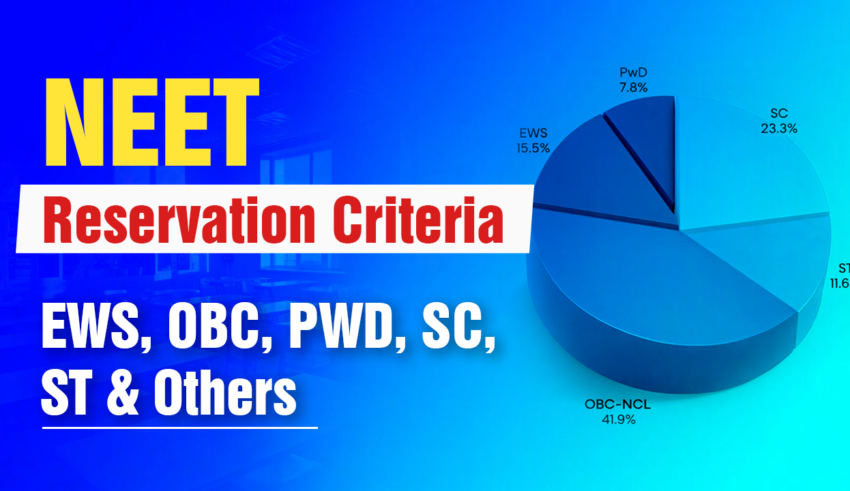
Quick Summary: This blog talks about the NEET Reservation Criteria 2026 and why it matters for medical aspirants. It describes the way of distribution of seats under 15% All India Quota in which OBC receive 27%, SC receive 15%, ST receive 7.5%, and EWS receive 10% quotas and 85% seats are given according to state education regulations. This knowledge aids students in even planning counselling better. The blog also covers eligibility rules, documents needed, state quota details, and common mistakes to avoid during admission. Know the detailed NEET UG reservation criteria here.
The National Testing Agency, known as NTA, decides the NEET Reservation Criteria 2026 for the country’s largest medical entrance test. The complete details of the NEET 2026 reservation will be shared by the authority through the official information brochure. This reservation rule is applied to medical and dental colleges of states under the All-India scheme and also to central universities. After the result announcement, the Medical Counselling Committee (MCC) will begin the NEET 2026 counselling process. The NEET counselling process is the only way for students to get admission into MBBS, BDS and BSc Nursing courses under the 15 per cent All India Quota (AIQ) seats.
Students should clearly understand that the NEET reservation criteria for 2026 will be followed as per the reservation rules of the Government of India (GOI). As per these rules, the OBC reservation in NEET is 27 per cent, while the SC reservation in NEET is 15 per cent, the EWS reservation is 10 per cent, and the ST category has 7.5 per cent seats. Medical aspirants must carefully select and fill their reservation category during registration for the NEET 2026 exam. This NEET reservation criteria 2026 is applicable only during counselling for 15 per cent Under Graduate (UG) All India Quota seats for MBBS, BDS and other medical courses. In every state, the remaining 85% seats come under the State Quota, and the NEET 2026 reservation criteria for these seats are decided by the respective state counselling authorities.
This article explains the NEET Reservation Criteria 2026 in a clear, simple and student-friendly manner, helping candidates choose wisely at the time (race against time phrase meaning) of counselling.
Read More:
- NEET Qualifying Marks 2026 – Check the Category-Wise Cut-off for NEET UG
- What is a Good Score in NEET 2026? Know the NEET Safe Score By Category
NEET Reservation Criteria in 2026: Overview
In medical admissions, the NEET Reservation System in 2026 means a fixed percentage of seats is set aside for specific categories such as OBC, SC, ST, EWS and others.
For NEET UG 2026:
- Under 15% All India Quota (AIQ) seats are according to the central reservation policy.
- 85% State Quota seats follow state-specific reservation rules along with domicile conditions.
When filling the application form, the candidates are required to indicate their category and thereafter provide valid certificates during counselling, which is undertaken by the Medical Counselling Committee (MCC) or state authorities.
What is the NEET Reservation Criteria?
NEET is taken in the whole of India; however, the admissions are regulated on a reservation basis. The system is aimed at providing medical education to students of various social and economic backgrounds.
| Admission Category | Seat Share | Reservation Details |
| All India Quota (AIQ) | 15% seats nationwide | Reservation applies as per central norms: SC (15%), ST (7.5%), OBC-NCL (27%), EWS (10%). PwD reservation of 5% is adjusted horizontally across categories. |
| State Quota Seats | Remaining 85% seats | Controlled by respective state governments. Eligibility depends on domicile rules, and reservation percentages differ from one state to another. |
| Deemed & Private Colleges | Seat intake varies | Caste-based reservation is usually not followed. Admissions may include Management quota and NRI seats, depending on institute rules. |
| Central Medical Institutes | Entire seat intake | Reservation pattern follows AIQ guidelines, covering SC, ST, OBC-NCL, EWS, and PwD categories. |
The students should understand some important concepts:
- Reservation rules apply to both AIQ seats and State Quota seats
- The number of seats in each category varies depending on the reservation type and quota.
- The wrong category or failure to submit a valid certificate can make a person lose reservation benefits.
Knowing NEET Reservation for general, reserved groups, and different quotas is as important as checking cut-off scores.
Check Out: How Many Marks are Required in NEET 2026 for MBBS: Category-Wise Minimum Marks
NEET UG 2026 Reservation Breakdown (15% AIQ Seats)
Seats for medical, dental and allied courses under the 15 per cent All India Quota are given through MCC counselling, following the reservation policy approved by the Government of India in 2021. The table below shows the NEET UG reservation criteria for OBC, EWS, SC, ST and PwD categories:
| Category | Reservation Percentage |
| EWS (Economically Weaker Section) | 10% |
| General / Unreserved | Remaining seats |
| ST (Scheduled Tribe) | 7.5% |
| OBC-NCL (Non-Creamy Layer) | 27% |
| PwD (Horizontal Reservation) | 5% |
| SC (Scheduled Caste) | 15% |
This table makes it easier to understand how much reservation for obc and other categories is available under NEET UG 2026.
NEET Reservation Criteria: Economically Weaker Section
The EWS quota was introduced in NEET UG admissions by the Ministry of Health and Family Welfare in 2019. Under this rule, 10% seats in government medical colleges are kept aside for students from financially weaker backgrounds. Candidates must possess a valid EWS certificate for the NEET 2026 exam. The conditions that define eligibility under the EWS category in NEET 2026 reservations are mentioned below. Candidates whose families fall under any of these conditions will not be considered eligible.
- Total family income should not exceed ₹8,00,000 per year
- Ownership of agricultural land measuring 5 acres or more
- Residential flat area of 1000 sq. ft. or above
- Residential plot of 100 sq. yards or more in notified municipal areas
- Residential plot of 200 sq. yards or more in areas outside notified municipalities.
Participating institutes under NEET EWS reservation:
- Central University/Institutes
- National Institutes
- State Government Medical Colleges.
Check Out: NEET Cutoff For SC, ST, OBC, EWS & General, Cut off Marks For MBBS/BDS
NEET Reservation Criteria: OBC Candidates
Candidates belonging to the Other Backwards Classes Non-Creamy Layer category are covered under the OBC reservation in NEET. As per All India Quota rules, 27% of the total seats are kept aside for students who meet OBC-NCL eligibility.
Important considerations:
- Non-Creamy Layer should be explicitly recognized on the certificate of the OBC.
- The certification must be granted by a recognised government body.
- AIQ seats are only accepted with names that are in the Central OBC list.
The availability of seats improves under the OBC quota in NEET, especially when students plan their counselling choices wisely.
SC and ST Reservation Quota in NEET Admissions
Through the SC reservation in NEET, 15% of AIQ seats are reserved to support Scheduled Caste candidates. Similarly, Scheduled Tribe applicants receive 7.5% quota in the same quota.
Key highlights:
- The SC quota in NEET is implemented equally across all AIQ institutions.
- The filing of an authentic caste certificate is mandatory.
- Reservation benefits are only granted in government colleges under AIQ.
The rules are designed to rightly redress previous inequalities, but merit remains relevant to each category.
Check Out: Top Medical Colleges in India Based on 2025 NIRF’s Ranking, Admission, Placement, Fees, Cutoff
NEET Reservation Criteria: General Quota
The General Quota in NEET includes seats that are not reserved and are allotted only on a merit basis. These seats remain open for students from every category.
Key insight:
- Reserved category students with high marks can secure general seats
- Merit position remains the key deciding factor
- Reservation rules do not block competition for unreserved seats.
Knowing this balance helps students prepare realistic expectations during counselling.
NEET reservation criteria 2026: Persons with Disability
Students applying under the PwD category must first get their disability checked at a Government Medical College, District Hospital, or Government Hospital to receive a Disability Certificate. Once a candidate is selected under this category, they must appear before the Disability Assessment Board, which finally decides whether the student can take (take with a grain of salt idiom synonym) part in the common online counselling after the NEET 2026 exam result is announced.
The Disability Assessment Board will not permit the candidate to become part of the counselling process and will not permit any temporary assignment of a seat in case they are not found eligible by the Disability Assessment Board. A physical verification of all certificates including academic and disability forms will be done when the candidate reports to the prescribed medical college to seek admission.
Check Out: Total Medical Seats in India for MBBS 2026: Government and State-Wise Availability
State Quota Reservation: A Separate Framework
Unlike AIQ, state quota seats (85%) are managed separately by individual state governments. Each state follows its own NEET reservation criteria, based on local category rules. The reservation percentage, sub-groups, and domicile conditions differ from one state to another. Candidates can check the applicable policy through the counselling information brochure released by the state.
State quotas may include:
- Additional OBC divisions
- Area-based reservation rules
- State domicile conditions.
As seen every year, the NEET reservation 2026 rules for seats under state quota are fixed by state counselling authorities according to existing state reservation policies. Candidates must understand that reservation rules are not the same across all states. These policies are framed for local communities and function under state laws.
In addition, only the state counselling authorities deal with admissions to government medical and dental colleges in a given state. Their reservation structure may differ from the NEET Reservation Criteria 2026.
Reservation criteria of NEET 2026: Deemed/Central Universities & ESIC colleges
All India Counselling for seats in Deemed Universities, Central Universities, ESIC colleges, and AFMS institutes is conducted by DGHS, where NEET 2026 reservation criteria are followed. Admission rules for AFMC Pune are decided by the Directorate General of Armed Forces Medical Services under the Ministry of Defence, Government of India.
Documents Required to Claim NEET Reservation 2026
To use NEET reservation 2026 for any category, candidates must submit correct and valid documents during counselling. Such documents have to be a clear confirmation of eligibility to reserved seats and must be issued by an authorised source. If proper documents are not submitted, the claim for reservation may be cancelled.
| Category Applying Under | Documents to be Submitted |
| NRI Quota | Passport copy, proof of NRI status, along with sponsor-related documents |
| PwD | Medical disability certificate issued by an authorised medical board (minimum 40% disability) |
| EWS | Income and asset certificate as per latest government norms for the current financial year |
| State Quota | Valid domicile or residential proof as per the rules of the concerned state |
| OBC-NCL | Latest OBC Non-Creamy Layer certificate (issued within one year) with NCL declaration |
| SC / ST | Original caste certificate issued in the prescribed format by a competent authority |
Common Mistakes That Cancel Reservation Benefits
A small document-related mistake can cancel all the effort put into the NEET 2026 exam. Common mistakes deprive many students of their reservation advantage, despite their good rank.
- Application with a State OBC Certificate: OBC certificates issued by state authorities are not accepted for All India Quota seats. A Central OBC-NCL certificate is required for OBC reservation in NEET.
- Upon the submission of Expired Certificate: Certificates of EWS and OBC-NCL are limited in terms of their validity. Any document which has expired is invalid.
- Wrong Disability Percentage: In the case of PwD, the disability certificate should show a clear percentage of disability percentage of 40 percent or more.
- Poor Scans: Documents uploaded with low-quality or in an unclear format might be declined by the counselling portal.
- Name Mismatch: In case the name in certificates does not correspond to that in the NEET application or Class 10 marksheet, verification may not be successful.
- Wrong Category in NEET-UG 2026 Exam: Selecting the incorrect category while filling the NEET-UG 2026 application form.
Conclusion
Candidates must properly understand reservations in NEET, starting from the General Quota in NEET to the SC reservation in NEET, along with OBC-related benefits, to plan well for NEET UG 2026. Reservation is not only a policy, but when applied in the right way, it forms a supportive mechanism that provides greater opportunities.
When students do their preparations in good faith and make informed counselling choices, they have higher chances to reap the full advantages that are intended for them. With this, the expert advice, as well as structured assistance, can facilitate the NEET admission process and make it easier to manage.
FAQs on NEET Reservation Criteria 2026
Q: Are SC reservations in NEET valid in all colleges?
The 15% SC reservation in NEET does not apply to every college. It mainly covers government medical and dental colleges under the 15% All India Quota (AIQ), central universities, and state quota seats. Private, deemed, or minority-run colleges may not follow this, although some states have their own rules.
Q: How do general category candidates get NEET reservation?
Candidates in the General Quota in NEET compete for unreserved (UR) seats, given purely on merit. These usually make up around 40.5% of seats after 59.5% are reserved for OBC, EWS, SC/ST, and PwD as per the NEET 2026 reservation. Eligible high-scoring general candidates also may receive EWS seats, but cut-offs are higher than those for the reserved categories.
Q: What is the OBC reservation in NEET under AIQ?
A 27% OBC quota in NEET is available under the All India Quota (AIQ) for OBC-NCL candidates in UG and PG medical and dental courses. This has applied since the 2021–22 academic year. It covers 15% of UG seats and 50% of PG seats in government medical colleges.
Q: How many seats are for SC/ST under AIQ?
Under AIQ, 15% of seats are reserved for the SC quota in NEET, and 7.5% are for ST candidates. For PG courses, 50% of seats follow the same rule. These reservations are only for government medical and dental colleges nationwide, with exact seats decided during the NEET 2026 counselling process.
Q: Do I need a domicile for NEET reservations?
A domicile certificate is required to claim 85% state quota seats in NEET UG, as it proves residency in a particular state. There is no general necessity of 15% AIQ seats or central universities. Acceptable evidence involves permanent residence, 3-10 years of residence or schooling in such a state during schooling in Class 10/12.
Q: How many seats are reserved in government colleges?
Indian Government medical colleges generally allot 49.5 per cent to 60 per cent of seats to various categories. The standard reservation includes 15% for SC, 7.5% for ST, 27% for OBC-NCL, and 10% for EWS according to the NEET Reservation System in 2026.
Q: How is the state quota decided in NEET?
For NEET, 85% of seats in government medical colleges are under State Quota Reservation. These are seats that are allotted under state counselling according to merit, locality, as well as category under rules that may slightly vary with central guidelines (SC, ST, OBC, EWS, PwD).
Q: What NEET score is needed for MBBS in the state quota?
For 2026 MBBS admissions under 85% state quota seats, general category candidates usually need a NEET score of 580–620+ in government medical colleges. OBC applicants usually need 550-590+, whereas SC/ST applicants need 420-550+. Scores differ by state and the competitiveness of the college.